MCQ
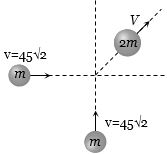
Two putty balls of equal mass moving with equal velocity in mutually perpendicular directions, stick together after collision. If the balls were initially moving with a velocity of $45\sqrt 2 \,m{s^{ - 1}}$ each, the velocity of their combined mass after collision is .................. $\mathrm{m} / \mathrm{s}^{-1}$
  • A
    $45\sqrt 2$
  • $45$
  • C
    $90$
  • D
    $22.5\sqrt 2$

Answer

Correct option: B.
$45$
b
(b)Initial momentum
$\vec P = m45\sqrt 2 \;\hat i + m45\sqrt 2 \;\hat j$ $⇒$ $|\vec P| = m \times 90$
Final momentum $2m \times V$
By conservation of momentum $2m \times V = m \times 90$
$V = 45\,m/s$

Need a full question paper?

Generate a complete, print-ready paper with questions like this in minutes — across 16+ boards, with answer keys.

Start Generating Free

Similar questions

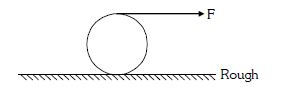
A solid sphere of radius $R$ is rolled by a force $F$ acting at the top of the sphere as shown in the figure. The sphere rolls without slipping on rough stationary surface.Initially sphere is in the rest position then
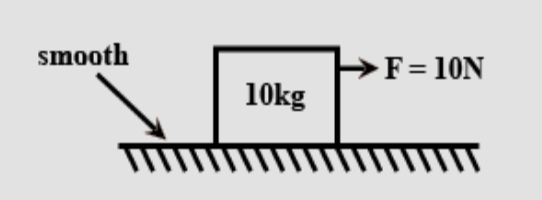
Force shown acts for 2 seconds. Find out work done by force F on 10kg in 3 seconds.
Two particles of equal mass go round a circle of radius $R$ under the action of their mutual gravitational attraction. The speed of each particle is
The least count of the main scale of a screw gauge is $1\, mm$. The minimum number of divisions on its circular scale required to measure $5\,\mu m$ diameter of a wire is
Four identical spheres each of mass $m$ are placed at the corners of square of side $2\,metre$. Taking the point of intersection of the diagonals as the origin, the co-ordinates of the centre of mass are
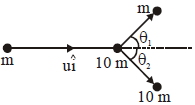
A particle of mass $m$ is moving along the $x$ -axis with initial velocity $u \hat i$. It collides elastically with a particle of mass $10\, m$ at rest and then moves with half its initial kinetic energy (see figure). If $\sin \theta_{1}=\sqrt{n} \sin \theta_{2}$ then value of $n$ is.....
The moleculear motion equation of gases is:
$'Torr'$ is the unit of
A particle is moving in a circle of radius $50 \mathrm{~cm}$ in such a way that at any instant the normal and tangential components of its acceleration are equal. If its speed at $t=0$ is $4 \mathrm{~m} / \mathrm{s}$, the time taken to complete the first revolution will be $\frac{1}{\alpha}\left[1-\mathrm{e}^{-2 \pi}\right] \mathrm{s}$, where $\alpha=$_______________.
The total energy for one mole of solid is: