MCQ
Two quantities $A$ and $B$ have different dimensions. Which mathematical operation given below is physically meaningful
  • $A/B$
  • B
    $A + B$
  • C
    $A - B$
  • D
    None

Answer

Correct option: A.
$A/B$
a
(a) Quantities having different dimensions can only be divided or multiplied but they cannot be added or subtracted.

Need a full question paper?

Generate a complete, print-ready paper with questions like this in minutes — across 16+ boards, with answer keys.
Start Generating Free

Similar questions

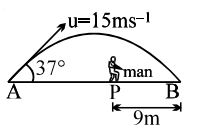
A ball is hit by a batsman at an angle of $37^o$ as shown in figure. The man standing at $P$ should run at what minimum velocity so that he catches the ball before it strikes the ground. Assume that height of man is negligible in comparison to maximum height of projectile.  ........ $ms^{-1}$
A car is moving towards a high cliff. The driver sounds a horn of frequency f. The reflected sound heard by the driver has a frequency 2f. If y be the velocity of sound, then the velocity of the car, in the same velocity units would be:
A student is performing the experiment of resonance column. The diameter of the column tube is $6 \,cm$. The frequency of the tuning fork is $504\, Hz$. Speed of the sound at the given temperature is $336\, m / s$. The zero of the meter scale coincides with the top end of the resonance column tube. The reading of the water level in the column when the first resonance occurs is..........$cm$
Speed of sound wave in air:
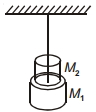
The length of wire, when $M_1$ is hung from it, is $I_1$ and is $I_2$ with both $M_1$ and $M_2$ hanging. The natural length of wire is ........
If the measurement errors in all the independent quantities are known, then it is possible to determine the error in any dependent quantity. This is done by the use of series expansion and truncating the expansion at the first power of the error. For example, consider the relation $z=x / y$. If the errors in $x, y$ and $z$ are $\Delta x, \Delta y$ and $\Delta z$, respectively, then

$z \pm \Delta z=\frac{x \pm \Delta x}{y \pm \Delta y}=\frac{x}{y}\left(1 \pm \frac{\Delta x}{x}\right)\left(1 \pm \frac{\Delta y}{y}\right)^{-1} .$

The series expansion for $\left(1 \pm \frac{\Delta y}{y}\right)^{-1}$, to first power in $\Delta y / y$, is $1 \mp(\Delta y / y)$. The relative errors in independent variables are always added. So the error in $z$ will be $\Delta z=z\left(\frac{\Delta x}{x}+\frac{\Delta y}{y}\right)$.

The above derivation makes the assumption that $\Delta x / x \ll<1, \Delta y / y \ll<1$. Therefore, the higher powers of these quantities are neglected.

($1$) Consider the ratio $r =\frac{(1- a )}{(1+ a )}$ to be determined by measuring a dimensionless quantity a.

If the error in the measurement of $a$ is $\Delta a (\Delta a / a \ll<1)$, then what is the error $\Delta r$ in

$(A)$ $\frac{\Delta a }{(1+ a )^2}$  $(B)$ $\frac{2 \Delta a }{(1+ a )^2}$  $(C)$ $\frac{2 \Delta a}{\left(1-a^2\right)}$  $(D)$ $\frac{2 a \Delta a}{\left(1-a^2\right)}$

($2$) In an experiment the initial number of radioactive nuclei is $3000$ . It is found that $1000 \pm$ 40 nuclei decayed in the first $1.0 s$. For $|x|<1$, In $(1+x)=x$ up to first power in $x$. The error $\Delta \lambda$, in the determination of the decay constant $\lambda$, in $s ^{-1}$, is

$(A) 0.04$  $(B) 0.03$  $(C) 0.02$  $(D) 0.01$

Give the answer or quetion ($1$) and ($2$)

The temperature of two bodies measured by a thermometer are $t_1 = 20\, ^oC + 0.5\, ^oC$ and $t_2 = 50\,^oC + 0.5\, ^oC$. The temperature difference and the error there in is
For an ideal gas the instantaneous change in pressure $'{p} '$ with volume $'v'$ is given by the equation $\frac{{dp}}{{dv}}=-{ap} .$ If ${p}={p}_{0}$ at ${v}=0$ is the given boundary condition, then the maximum temperature one mole of gas can attain is :

(Here ${R}$ is the gas constant)

A force is represented by $\mathrm{F}=a \mathrm{x}^2+\mathrm{bt}^{1 / 2}$. Where $\mathrm{x}=$ distance and $\mathrm{t}=$ time. The dimensions of $\mathrm{b}^2 / \mathrm{a}$ are :
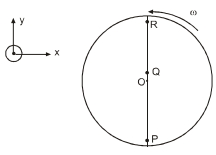
Consider a disc rotating in the horizontal plane with a constant angular speed $\omega$ about its centre $O$. The disc has a shaded region on one side of the diameter and an unshaded region on the other side as shown in the figure. When the disc is in the orientation as shown, two pebbles $P$ and $Q$ are simultaneously projected at an angle towards $R$. The velocity of projection is in the $y$-z plane and is same for both pebbles with respect to the disc. Assume that $(i)$ they land back on the disc before the disc completed $\frac{1}{8}$ rotation. $(ii)$ their range is less than half disc radius, and $(iii)$ $\omega$ remains constant throughout. Then