MCQ
Two radioactive materials $A$ and $B$ have decay constant $5\lambda$ and $\lambda$ respectively.At $t=0$  they have the same number of nuclei, then the ratio of the number of nuclei of $A$ to that $B$ will be $(1/e)^2$ after a time interval
  • A
    $4λ$
  • B
    $2λ$
  • $\frac{1}{{2\lambda }}$
  • D
    $\;\frac{1}{{4\lambda }}$

Answer

Correct option: C.
$\frac{1}{{2\lambda }}$
c
Given : $\lambda_{A}=5 \lambda$, $\lambda_{B}=\lambda$

At $t=0,\left(N_{0}\right)_{A}=\left(N_{0}\right)_{B}$

$\frac{N_{A}}{N_{B}}=\left(\frac{1}{e}\right)^{2}$

According to radioactive decay, $\frac{N}{N_{0}}=e^{-\lambda t}$

$\therefore \,\frac{N_{A}}{\left(N_{0}\right)_{A}} =e^{-\lambda_{A} t} $  ..... $(i)$

$\frac{N_{B}}{\left(N_{0}\right)_{B}} =e^{-\lambda_{B} t}$  ..... $(ii)$

Divide $(i)$ by $(ii)$, we get

$\frac{N_{A}}{N_{B}}=e^{-\left(\lambda_{A}-\lambda_{B}\right) t}$  or, $\frac{N_{A}}{N_{B}}=e^{-(5 \lambda-\lambda) t}$

or, $\left(\frac{1}{e}\right)^{2}=e^{-4 \lambda t}$ or,  $\left(\frac{1}{e}\right)^{2}=\left(\frac{1}{e}\right)^{4 \lambda t}$

or, $4 \lambda t=2$ $ \Rightarrow \quad t=\frac{2}{4 \lambda}=\frac{1}{2 \lambda}$

Need a full question paper?

Generate a complete, print-ready paper with questions like this in minutes — across 16+ boards, with answer keys.

Start Generating Free

Similar questions

A lamp emits monochromatic green light uniformly in all directions. The lamp is $3\%$ efficient in converting electrical power to electromagnetic waves and consumes $100\,W$ of power . The amplitude of the electric field associated with the electromagnetic radiation at a distance of $5\,m$ from the lamp will be nearly.......$V/m$
A particle starts moving rectilinearly at time $t = 0$ such that its velocity $'v'$ changes with time $'t'$ according to the equation $v = t^2 - t$ where $t$ is in seconds and $v$ is in $m/s.$ The time interval for which the particle retards is
For the reaction given below :

The compound which is not formed as a product in the reaction is a :

In a plane electromagnetic wave travelling in free space, the electric field component oscillates sinusoidally at a frequency of $2.0 \times 10^{10}\,Hz$ and amplitude $48\,Vm ^{-1}$. Then the amplitude of oscillating magnetic field is : (Speed of light in free space $=3 \times 10^8\,m s ^{-1}$)
An imaginary line joining the optical centre of the eye lens and the yellow point is called as
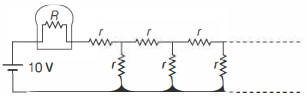
A light bulb of resistance $R=16 \,\Omega$ is attached in series with an infinite resistor network with identical resistances $r$ as shown below. A $10 \,V$ battery drives current in the circuit. ............. $\Omega$ the value of $r$ such that the bulb dissipates about $1 \,W$ of power.
At room temperature $\left(27^{\circ} \mathrm{C}\right)$, the resistance of a heating element is $50 \Omega$. The temperature coefficient of the material is $2.4 \times 10^{-4}{ }^{\circ} \mathrm{C}^1$. The temperature of the element, when its resistance is $62 \Omega$, is $\qquad$ ${ }^{\circ} \mathrm{C}$.
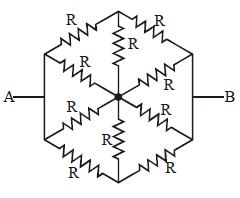
Find out equivalent resistance between $A$ and $B$
A convex lens, a glass slab, a glass prism and a solid sphere all are made of the same glass, the dispersive power will be
The stopping potential for photoelectrons emitted from a surface illuminated by light of wavelength $6630 \; \mathring A$ is $0.42 \; V$. If the threshold frequency is $x \times$ $10^{13}  / s$, where $x$ is$\dots$ (nearest integer).

(Given, speed light $=3 \times 10^{8} \; m / s$, Planck's constant $=6.63 \times 10^{-34} \; Js$ )