MCQ
Two radioactive materials $A$ and $B$ have decay constants $10\,\lambda $ and $\lambda $, respectively. If initially they have the same number of nuclei, then the ratio of the number of nuclei of a to that of $B$ will be $1/e$ after a time
  • A
    $\frac{1}{{11\lambda }}$
  • B
    $\frac{1}{{10\lambda }}$
  • $\frac{1}{{9\lambda }}$
  • D
    $\frac{11}{{10\lambda }}$

Answer

Correct option: C.
$\frac{1}{{9\lambda }}$
c
${{\text{N}}_1} = {{\text{N}}_0}{{\text{e}}^{ - 10\lambda t}}$ ;  $\mathrm{N}_{2}=\mathrm{N}_{0} \mathrm{e}^{-\lambda \mathrm{t}}$

$\frac{1}{e}=\frac{N_{1}}{N_{2}}=e^{-9 \lambda t}$

$\Rightarrow 9 \lambda t=1$

$\Rightarrow t=\frac{1}{9 \lambda}$

Need a full question paper?

Generate a complete, print-ready paper with questions like this in minutes — across 16+ boards, with answer keys.

Start Generating Free

Similar questions

A convex lens of focal length $40 \mathrm{~cm}$ forms an image of an extended source of light on a photoelectric cell. A current I is produced. The lens is replaced by another convex lens having the same diameter but focal length $20 \mathrm{~cm}$. The photoelectric current now is:
A slender rod of mass $M$ and length $L$ is hinged about an end to swing freely in a vertical plane. However, its density is nonuniform and varies linearly from hinged end to the free end doubling its value. The moment of inertia of the rod, about the rotation axis passing through the hinge point is
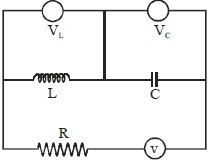
A series $R L C$ circuit is shown here. The source frequency $f$ is varied, but the current is kept unchanged. Which of the curves showing changes of $V_C$ and $V_L$ with frequency would be valid for  he circuit under consideration?
If a particle of charge ${10^{ - 12}}\,coulomb$ moving along the $\hat x - $ direction with a velocity ${10^5}\,m/s$ experiences a force of ${10^{ - 10}}\,newton$ in $\hat y - $ direction due to magnetic field, then the minimum magnetic field is
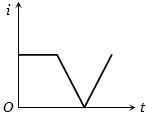
The current $i$ in an induction coil varies with time $t$ according to the graph shownin figure. Which of the following graphs shows the induced emf $(E$) in the coil with time
In a $dc$ motor, induced $e.m.f.$ will be maximum
A star has $10^{40}$ deuterons. It produces energy via the process,

$_1{H^2}{ + _1}{H^2}{ \to _1}{H^3} + P$  and

$_1{H^2}{ + _1}{H^3}{ \to _2}{He^4} + n$ 

If the averages power radiated by the star is $10^{16}\ W, $ the deuteron supply of the star is exhausted in a time of the order of :

Given: mass of $_1H{^2}$  = $2.041\ amu$ 

            mass of $_2H{e^4}$ = $4.001\ amu$

            mass of $proton = 1.007\ amu$

            mass of $neutron = 1.008\ amu$        

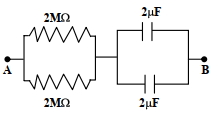
At time $\mathrm{t}=0$, a battery of $10 \mathrm{~V}$ is connected across points $\mathrm{A}$ and $\mathrm{B}$ in the given circuit. If the capacitors have no charge initially, at what time (in seconds) does the voltage across them becomes $4$ volt?

[take $\ln 5=1.6, \ln 3=1.1]$

In a thermodynamic process pressure of a fixed mass of a gas is changed in such a manner that the gas releases $20 \,J$ of heat when $8 \,J$ of work was done on the gas. If the initial internal energy of the gas was $30 \,J$, then the final internal energy will be ........ $J$
In the motion of a projectile freely under gravity, its