Question
Two rays A and B being reflected by a mirror and going as A' and B'. The mirror:
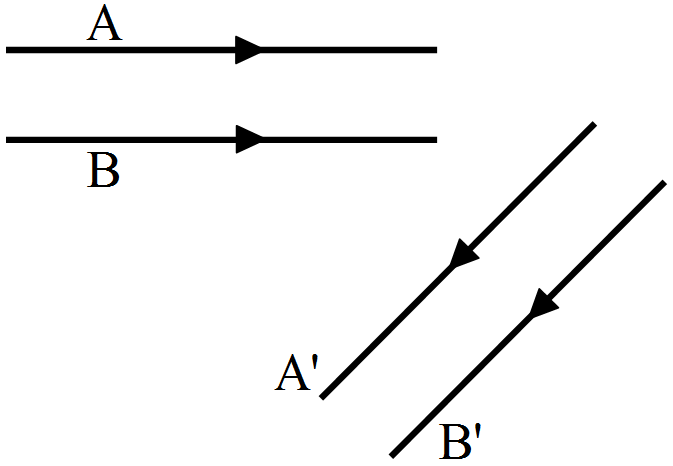
- Is plane.
- Is convex.
- Is concave.
- May be any spherical mirror.
Explanation:
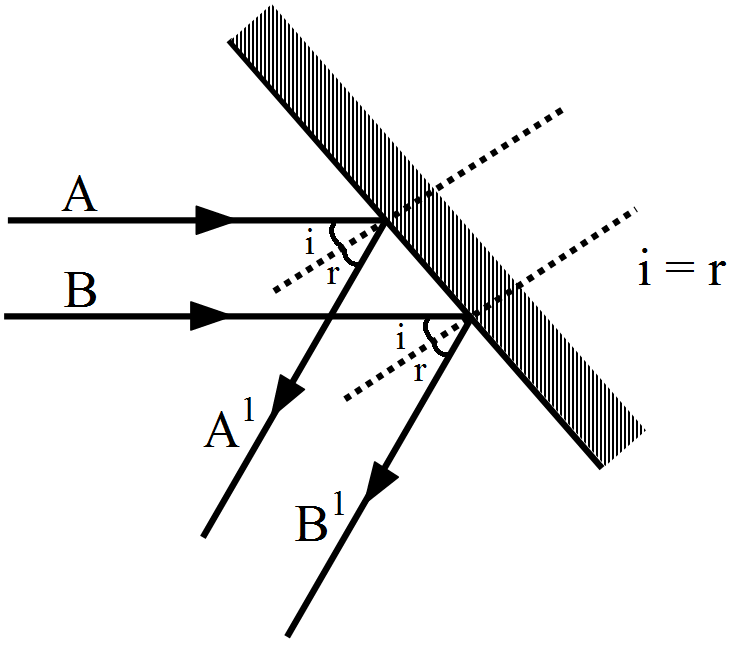
Here initially A & B is parallel to each other after reflection by teh plane mirror A' & B' goes Parallel to each other.
Generate a complete, print-ready paper with questions like this in minutes — across 16+ boards, with answer keys.
A varying current at the rate of 3 A/s in a coil generates an e.m.f. of 8 mV in a nearby coil. The mutual inductance of the two coils is
|
(a) 2.66 mH |
(b) 2.66 |
(c) 2.66 H |
(d) 0.266 H |
When the temperature of silicon sample is increased from 27℃ to 100℃, the conductivity of silicon will be
|
(a) Increased |
(b) Decreased |
(c) Remain same |
(d) Zero |
Two plates are at potentials –10 V and +30 V. If the separation between the plates be 2 cm. The electric field between them is
|
(a) 2000 V/m |
(b) 1000 V/m |
(c) 500 V/m |
(d) 3000 V/m |
The torque on a bar magnet due to the earth's magnetic field is maximum when the axis of the magnet is
|
(a) Perpendicular to the field of the earth |
|
(b) Parallel to the vertical component of the earth's field |
|
(c) At an angle of 33o with respect to the N-S direction |
|
(d) Along the North-South (N-S) direction |
A rod of a certain metal is 1.0 m long and 0.6 cm in diameter. Its resistance is 3.0 ×  ohm. Another disc made of the same metal is 2.0 cm in diameter and 1.0 mm thick. What is the resistance between the round faces of the disc
|
(a) 1.35 × |
(b) 2.70 × |
(c) 4.05 × |
(d) 8.10 × |
Huygen’s principle of secondary wavelets may be used to
|
(a) Find the velocity of light in vacuum |
|
(b) Explain the particle behaviour of light |
|
(c) Find the new position of the wavefront |
|
(d) Explain photoelectric effect |


