MCQ
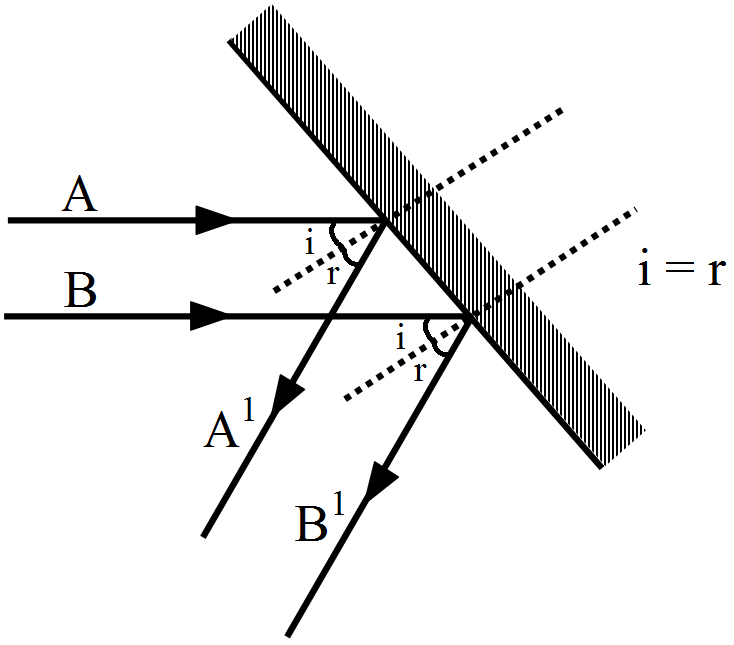
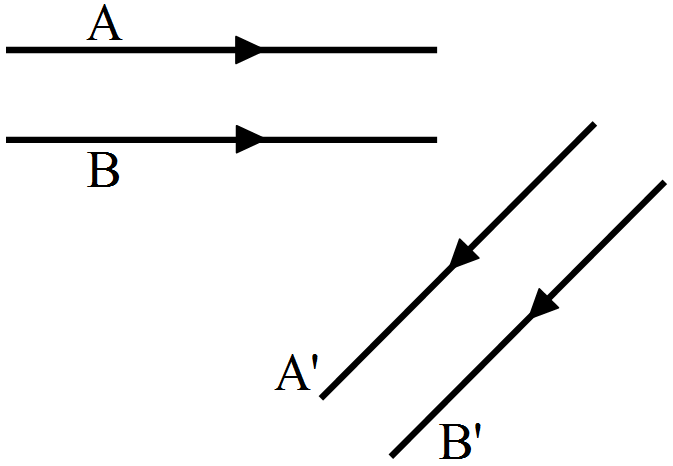
Two rays $A$ and $B$ being reflected by a mirror and going as $A'$ and $B'$. The mirror:
  • Is plane.
  • B
    Is convex.
  • C
    Is concave.
  • D
    May be any spherical mirror.

Answer

Correct option: A.
Is plane.


Here initially $A\ \&\ B$ is parallel to each other after reflection by teh plane mirror $A'\ \&\ B'$ goes Parallel to each other.

Need a full question paper?

Generate a complete, print-ready paper with questions like this in minutes — across 16+ boards, with answer keys.
Start Generating Free

Similar questions

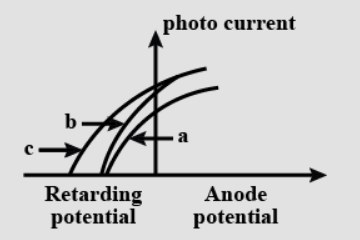
The figure shows a plot of photocurrent v/s anode potential for a photo sensitive surface for three different radiations. Which one of the following is a correct statement?
Two coaxial solenoids $1$ and $2$ of the same length are set so that one is inside the other. The number of turns per unit length are ${n_1}$ and ${n_2}$. The currents ${i_1}$ and ${i_2}$ are flowing in opposite directions. The magnetic field inside the inner coil is zero. This is possible when
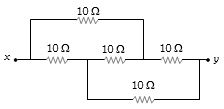
The equivalent resistance between $x$ and $y$ in the circuit shown is ............. $\Omega$
A polaroid is placed at $45^\circ$ to an incoming light of intensity $I _0$. Now the intensity of light passing through polaroid after polarisation would be
In an $ac$ circuit, the current lags behind the voltage by $\pi /3$. The components in the circuit are    
A circular loop carrying a current is replaced by an equivalent magnetic dipole. A point on the axis of the loop is
An $LCR$ series circuit with $100 \,\Omega$ resistance is connected to an $AC$ source of $200\, V$ and angular frequency $300$ radians per second. When only the capacitance is removed, the current leads the voltage by $60^o .$ Then the current and power dissipated in $LCR$ circuit are respectively
What kind of image is obtained always for concave lens?
A particle has a mass 400 times than that of the electron and charge is double than that of a electron. It is accelerated by 5V of potential difference. Initially the particle was at rest, then its final kinetic energy will be
The electric field part of an electromagnetic wave in a medium is represented by $E_x = 0\,;$

${E_y} = 2.5\,\frac{N}{C}\,\,\cos \,\left[ {\left( {2\pi \, \times \,{{10}^6}\,\frac{{rad}}{m}} \right)t - \left( {\pi  \times {{10}^{ - 2}}\frac{{rad}}{s}} \right)x} \right];$

$E_z = 0$. The wave is