Two resistance wires on joining in parallel the resultant resistance is $\frac{6}{5}\,ohms$. One of the wire breaks, the effective resistance is $2\,ohms$. The resistance of the broken wire is ............ $ohm$
Medium


Download our appand get started for free
Experience the future of education. Simply download our apps or reach out to us for more information. Let's shape the future of learning together!No signup needed.*
Similar Questions
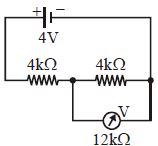
- 1What will be reading of voltmeter ................. $V$View Solution
- 2Wheatstone bridge principle is used to measure the specific resistance $\left(S_1\right)$ of given wire, having length $L$, radius $r$. If $X$ is the resistance of wire, then specific resistance is: $S_1=X\left(\frac{\pi r^2}{L}\right)$. If the length of the wire gets doubled then the value of specific resistance will be :View Solution
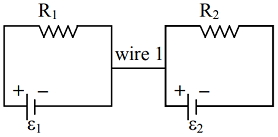
- 3In the circuit, wire $1$ is of negligible resistance. Then,View Solution
- 4View SolutionTwo bulbs of equal wattage, one having carbon filament and the other having a tungsten filament are connected in series to the mains, then
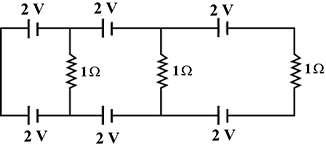
- 5View SolutionIn the below circuit the current in each resistance is
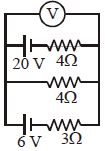
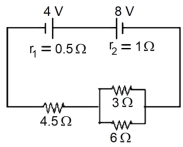
- 6In the circuit diagram shown in figure given below, the current flowing through resistance $3\, \Omega$ is $\frac{ x }{3}\,A$. The value of $x$ is $...........$View Solution
- 7View SolutionIn the circuits shown below, the readings of the voltmeters and the ammeters will be
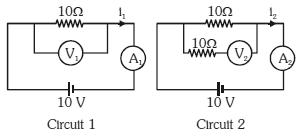
- 8The figure shows a network of four resistances and three batteries The current through the branch $CF$ is ............... $A$View Solution
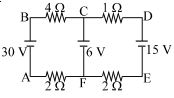
- 9What will be equivalent resistance of circuit between $x$ and $y$View Solution
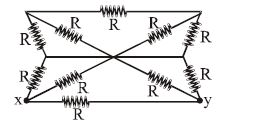
- 10The percentage error in the reading of the voltmeter in the figure shown here is nearly ............ $\%$View Solution