Two resistances $R_1=X \Omega$ and $R_2=1 \Omega$ are connected to a wire $A B$ of uniform resistivity, as shown in the figure. The radius of the wire varies linearly along its axis from $0.2 mm$ at $A$ to $1 mm$ at $B$. A galvanometer ($G$) connected to the center of the wire, $50 cm$ from each end along its axis, shows zero deflection when $A$ and $B$ are connected to a battery. The value of $X$ is. . . . .
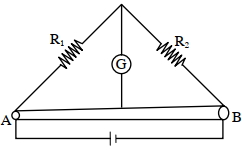
IIT 2022, Advanced


Download our appand get started for free
Experience the future of education. Simply download our apps or reach out to us for more information. Let's shape the future of learning together!No signup needed.*
Similar Questions
- 1A long solenoid of $50\, cm$ length having $100$ turns carries a current of $2.5$ $A.$ The magnetic field at the centre of the solenold is $...... \times 10^{-5}\;T$View Solution
$\left(\mu_{0}=4 \pi \times 10^{-7}\, T\, m\, A ^{-1}\right)$
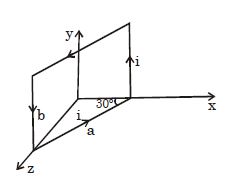
- 2Current $'i'$ is flowing in the rectangular loop placed in the $xyz$ plane as shown in the figure. Find the magnetic moment of the loopView Solution
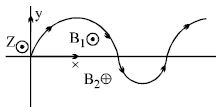
- 3At $t = 0$ a charge $q$ is at the origin and moving in the $y-$ direction with velocity $\overrightarrow v = v\,\hat j .$ The charge moves in a magnetic field that is for $y > 0$ out of page and given by $B_1 \hat z$ and for $y < 0$ into the page and given $-B_2 \hat z .$ The charge's subsequent trajectory is shown in the sketch. From this information, we can deduce thatView Solution
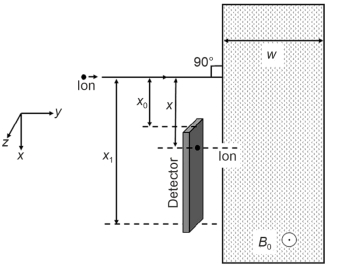
- 4A positive, singly ionized atom of mass number $A_M$ is accelerated from rest by the voltage $192 V$. Thereafter, it enters a rectangular region of width $w$ with magnetic field $B_0=0.1 \hat{k}$ Tesla, as shown in the figure. The ion finally hits a detector at the distance $x$ below its starting trajectory.View Solution
[Given: Mass of neutron/proton $=(5 / 3) \times 10^{-27} kg$, charge of the electron $=1.6 \times 10^{-19} C$.]
Which of the following option($s$) is(are) correct?
$(A)$ The value of $x$ for $H^{+}$ion is $4 cm$.
$(B)$ The value of $x$ for an ion with $A_M=144$ is $48 cm$.
$(C)$ For detecting ions with $1 \leq A_M \leq 196$, the minimum height $\left(x_1-x_0\right)$ of the detector is $55 cm$.
$(D)$ The minimum width $w$ of the region of the magnetic field for detecting ions with $A_M=196$ is $56 cm$.
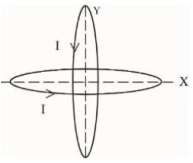
- 5Two identical circular wires of radius $20\,cm$ and carrying current $\sqrt{2}\,A$ are placed in perpendicular planes as shown in figure. The net magnetic field at the centre of the circular wire is $.............\times 10^{-8}\,T$. (Take $\pi=3.14$ )View Solution
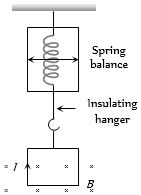
- 6A square loop of side $a$ hangs from an insulating hanger of spring balance. The magnetic field of strength $B$ occurs only at the lower edge. It carries a current $I$. Find the change in the reading of the spring balance if the direction of current is reversedView Solution
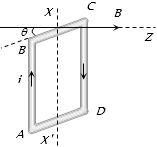
- 7The square loop $ABCD$, carrying a current $i$, is placed in uniform magnetic field $B$, as shown. The loop can rotate about the axis $XX$'. The plane of the loop makes and angle $\theta$ ($\theta$ $< 90^o$) with the direction of $B$. Through what angle will the loop rotate by itself before the torque on it becomes zeroView Solution
- 8In a moving coil galvanometer, the deflection of the coil $\theta $ is related to the electrical current $i$ by the relationView Solution
- 9The magnetic field at the centre of coil of $n$ $turns$, bent in the form of a square of side $2l$ , carrying current $i$, isView Solution
- 10A circular coil has moment of inertia $0.8 \,kg m ^{2}$ around any diameter and is carrying current to roduce a magnetic moment of $20\, Am ^{2}$. The coil is kept initially in a vertical position and it can rotate freely around a horizontal diameter. When a uniform magnetic field of $4\, T$ is applied along the vertical, it starts rotating around its horizontal diameter. The angular speed the coil acquires after rotating by $60^{\circ}$ will beView Solution