Question
Two resistors are connected (a) in series (b) in parallel. The equivalent resistance in the two cases are 9 ohm and 2 ohm respectively. Then the resistances of the component resistors are(a) 2 ohm and 7 ohm(b) 3 ohm and 6 ohm(c) 3 ohm and 9 ohm(d) 5 ohm and 4 ohm
       

Answer

(b) 3 ohm and 6 ohm

Need a full question paper?

Generate a complete, print-ready paper with questions like this in minutes — across 16+ boards, with answer keys.

Start Generating Free

Similar questions

What is the atomic mass (u) of chlorine?
While a collector to emitter voltage is constant in a transistor, the collector current changes by $8.2\ mA$ when the emitter current changes by $8.3\ mA.$ The value of forward current ratio $h_{fe}$ is
The work function of a metal is $ hc/\lambda_{0} $. Light of wavelength $ \lambda $ is incident on the surface of the metal. For emission of electrons from the metal the condition is :
When N-type of semiconductor is heated(a) Number of electrons increases while that of holes decreases(b) Number of holes increases while that of electrons decreases(c) Number of electrons and holes remains same(d) Number of electrons and holes increases equally


The light of wavelength 6328 Å is incident on a slit of width 0.2 mm perpendicularly, the angular width of central maxima will be(a) 0.36°(b) 0.18 °(c) 0.72°  (d) 0.09°
       
Which of the following pairs has quantities of the same dimensions?
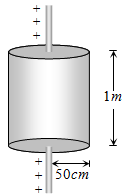
Electric charge is uniformly distributed along a long straight wire of radius $1\ mm$. The charge per $cm$ length of the wire is $Q$ coulomb. Another cylindrical surface of radius $50 \ cm$ and length $1m$ symmetrically encloses the wire as shown in the figure. The total electric flux passing through the cylindrical surface is
Which of the following statements is correct(a) The current in a photocell increases with increasing frequency of light(b) The photocurrent is proportional to applied voltage(c) The photocurrent increases with increasing intensity of  light(d) The stopping potential increases with increasing intensity of incident light


When the light source is approaching, the Doppler effect for light is known as:
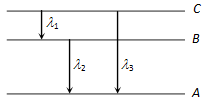
Energy levels $\text{A, B, C}$ of a certain atom corresponding to increasing values of energy i.e.$\mathrm{E}_{\mathrm{A}}<\mathrm{E}_{\mathrm{B}}<\mathrm{E}_{\mathrm{C}} $ if $\quad \lambda_1, \lambda_2, \lambda_3$ are the wavelengths of radiations corresponding to the transitions $C$ to $B, B$ to $A$ and $C$ to $A$ respectively, which of the following statements is correct