Question
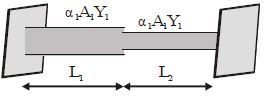
Two rods are joined between fixed supports as shown in the figure. Condition for no change in the lengths of individual rods with the increase of temperature will be

( ${\alpha _1},\,{\alpha _2},$ = linear expansion coefficient

$A_1, A_2$ = Area of rods

$Y_1, Y_2$ = Young modulus)
Answer

$Y=\frac{\text { Stress }}{\text { Strain }}=\frac{T / A}{\Delta l / l}$

$\mathrm{T}=\frac{\mathrm{Y} \Delta l}{l}=\mathrm{A}=\mathrm{Y} \cdot \mathrm{A} \alpha \Delta \mathrm{T}$

In both the rods tension will be some so

$\mathrm{T}_{1}=\mathrm{T}_{2},$ Hence $\mathrm{Y}_{1} \mathrm{A}_{1} \alpha_{1} \Delta \mathrm{T}=\mathrm{Y}_{2} \mathrm{A}_{2} \alpha_{2} \Delta \mathrm{T}$

$\frac{A_{1}}{A_{2}}=\frac{Y_{2} \alpha_{2}}{Y_{1} \alpha_{1}}$

Need a full question paper?

Generate a complete, print-ready paper with questions like this in minutes — across 16+ boards, with answer keys.

Start Generating Free

Similar questions

A horizontal disc of moment of inertia $4.25 \,kg - m ^2$ with respect to its axis of symmetry is spinning counter clockwise at 15 rps about its axis, as viewed from above. A second disc of moment of inertia $1.80 \,kg - m ^2$ with respect to its axis of symmetry is spinning clockwise at $25 \,rps$ as viewed from above about the same axis and is dropped on top of the first disc. The two discs stick together and rotate as one about their axis of symmetry. The new angular velocity of the system as viewed from above is close to
Find equivalent resistance $b / w \quad A$ and $B$ :
Image
If a lighter body (mass ${M_1}$ and velocity ${V_1}$) and a heavier body (mass ${M_2}$ and velocity ${V_2}$) have the same kinetic energy, then
The top of a lake gets frozen at a place where the surrounding air is at a temperature of $-20\,^oC$. Then
If $g \propto \frac{1}{{{R^3}}}$ (instead of $\frac{1}{{{R^2}}}),$ then the relation between time period of a satellite near earth's surface and radius $R$ will be
According to Bohr's atomic model angular momentum of electron in $5^{th}$ orbit of $H-$ atom is
A train is moving towards north. At one place it turns towards north-east, here we observe that
A small toy starts moving from the position of rest under a constant acceleration. If it travels a distance of $10 \,m$ in $t \;s ,$ the distance travelled by the toy in the next $t s$ will be .........$m$
Consider a finite insulated, uncharged conductor placed near a finite positively charged conductor. The uncharged body must have a potential
The first overtone of a stretched wire of given length is $320 Hz$. The first harmonic is  .... $Hz$