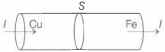
Two rods of copper and iron with the same cross-sectional area are joined at $S$ and a steady current $I$ flows through the rods as shown in the figure. Choose the most appropriate representation of charges accumulated near the junction $S$.
KVPY 2018, Diffcult
Download our app for free and get started
$(b)$ When a current flows through a junction or a contact between two metals of different conductivities a charge is accumulated in the vicinity of contact. The charge accumulation is directly proportional to the current. Charge accumulation occurs in a region whose thickness is nearly equals to the mean free path in the metal.
In case current flows from a metal of large conductivity to a metal of small conductivity, charge accumulation is of positive type and vise-versa. So, correct option is $(b)$.

Download our appand get started for free
Experience the future of education. Simply download our apps or reach out to us for more information. Let's shape the future of learning together!No signup needed.*
Similar Questions
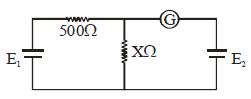
- 1In the adjoining circuit, the battery $E_1$ has an emf of $12\, volt$ and zero internal resistance while the battery $E_2$ has an $emf$ of $2\, volt$. If the galvanometer $G$ reads zero, then the value of the resistance $X$ (in $ohm$ ) isView Solution
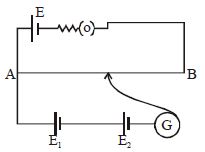
- 2In given arrangement $E_1 = 5\, volts$ $E_2 = 7\, volt$ balancing length is $6\,m$ if terminals of $E_2$ are reversed then new balancing length will beView Solution
- 3An electric kettle has two heating coils. When one of the coils is connected to an a.c. sotuce, the water in the kettle boils in $10$ minutes. When the other coil is used the w’ater boils in $40$ minutes. If both the coils are connected in parallel, the time taken by the same quantity of water to boil will be ...... $min$View Solution
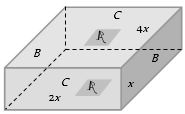
- 4In figure shows a rectangular block with dimensions $x,\, 2x$ and $4x$. Electrical contacts can be made to the block between opposite pairs of faces (for example, between the faces labelled $A-A, B-B$ and $C-C$). Between which two faces would the maximum electrical resistance be obtained ($A-A$ : Top and bottom faces, $B-B$ : Left and right faces, $C-C$ : Front and rear faces)View Solution
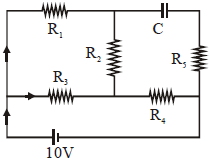
- 5An ideal cell of emf $10\, V$ is connected in circuit shown in figure. Each resistance is $2\, \Omega .$ The potential difference (in $V$) across the capacitor when it is fully charged isView Solution
- 6The energy consumed in $1\, Kwatt$ electric heater in $30$ seconds will beView Solution
- 7Two resistors are joined in parallel whose, resultant is $\frac{6}{5} \,\Omega$. One of the resistance wire is broken and the effective resistance becomes $2 \,ohms$. Then the resistance (in $ohm$) of the wire that got broken is ..........View Solution
- 8If a wire of resistance $20\,\Omega $ is covered with ice and a voltage of $210\, V$ is applied across the wire, then the rate of melting of ice is .................. $g/s$View Solution
- 9The charge flowing in a conductor changes with time as $Q ( t )=\alpha t -\beta t ^2+\gamma t ^3$. Where $\alpha, \beta$ and $\gamma$ are constants. Minimum value of current is :View Solution
- 10A wire has a resistance of $12\, ohm$. It is bent in the form of equilateral triangle. The effective resistance between any two corners of the triangle isView Solution