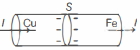
Two rods of copper and iron with the same cross-sectional area are joined at $S$ and a steady current $I$ flows through the rods as shown in the figure. Choose the most appropriate representation of charges accumulated near the junction $S$.
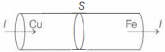
- A
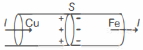
- B
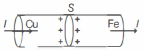
- C
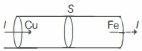
- D
KVPY 2018, Diffcult


Download our appand get started for free
Experience the future of education. Simply download our apps or reach out to us for more information. Let's shape the future of learning together!No signup needed.*
Similar Questions
- 1A rod of length $l$ with thermally insulated lateral surface is made of a material whose thermal conductivity $K$ varies as $K = C/T$ , where $C$ is a constant. The ends are at temperatures $T_1$ and $T_2$ . The heat current density isView Solution
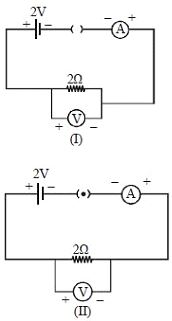
- 2For the circuits shown in figures $I$ and $II$, the voltmeter reading would beView Solution
- 3The value of internal resistance of an ideal cell is $\Omega$View Solution
- 4A $50\,V$ battery is connected across a $10\, ohm$ resistor. The current is $4.5\, amperes$. The internal resistance of the battery is ............. $ohm$View Solution
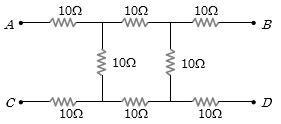
- 5What will be the equivalent resistance between the two points $A$ and $D$ ............. $\Omega$View Solution
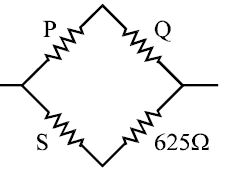
- 6$A$ Wheatstone's bridge is balanced with a resistance of $625\, \Omega$ in the third arm, where $P, Q$ and $S$ are in the $1^{st}, 2^{nd}$ and $4^{th}$ arm respectively. If $P$ and $Q$ are interchanged, the resistance in the third arm has to be increased by $51\,\Omega$ to secure balance. The unknown resistance in the fourth arm is ............. $\Omega$View Solution
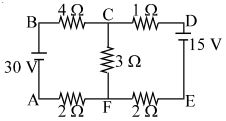
- 7The figure shows a network of five resistances and two batteries The current through the $30\,V$ battery is ............... $A$View Solution
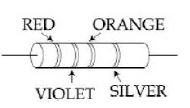
- 8View SolutionA resistance is shown in the figure. Its value and tolerance are given respectively by
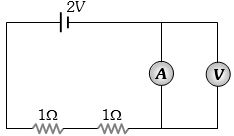
- 9In the circuit shown, $A$ and $V$ are ideal ammeter and voltmeter respectively. Reading of the voltmeter will be ............... $V$View Solution
- 10Kirchhoff's first law $i.e.$ $\Sigma i = 0$ at a junction is based on the law of conservation ofView Solution