MCQ
Two rods of different materials having coefficient of thermal expansion $\alpha_1,\alpha_2$ and Young's modulus $Y_1, Y_2$, respectively are fixed between two rigid massive walls. The rods are heated such that they undergo the same increase in temperature. There is no bending of the rods. If $\alpha_1:\alpha_2=2:3,$ the thermal stresses developed in the two rods are equal provided $Y_1 : Y_2$ is equal to:
  • A
    $2 : 3$
  • B
    $1 : 1$
  • $3 : 2$
  • D
    $4 : 9$

Answer

Correct option: C.
$3 : 2$
Expansion in rod due to rise in temperature $=$ compression in rod,
$\therefore\frac{\alpha_1}{\alpha_2}=\frac{\text{Y}_1}{\text{Y}_2}$ or $\frac{\alpha_2}{\alpha_1}=\frac{3}{2}$

Need a full question paper?

Generate a complete, print-ready paper with questions like this in minutes — across 16+ boards, with answer keys.

Start Generating Free

Similar questions

At  ..... $km$ height from the surface of earth the gravitation potential and the value of $g$ are  $-5.4 \times 10^7\, J kg^{-1}$ and $6.0\,m s^{-2}$ respectively . Take the radius of earth as $6400\, km$.
An experiment is performed to obtain the value of acceleration due to gravity $g$ by using a simple pendulum of length $L$. In this experiment time for $100\, oscillations$ is measured by using a watch of $1\, second$ least count and the value is $90.0\, seconds$. The length $L$ is measured by using a meter scale of least count $1\, mm$ and the value is $20.0\, cm$. The  error in the determination of $g$ would be  ........... $\%$
A uniform rod of length $2.0 \,m$ is suspended through an end and is set into oscillation with small amplitude under gravity. The time period of oscillation is approximately .... $\sec$
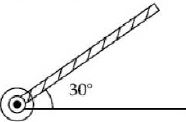
A rod of length $50\,cm$ is pivoted at one end. It is raised such that if makes an angle of $30^o$ fro the horizontal as shown and released from rest. Its angular speed when it passes through the horizontal (in $rad\,s^{-1}$ ) will be $(g = 10\,ms^{-2})$
In the kinetic theory of gases, which of these statements is/are true ?

$(i)$ The pressure of a gas is proportional to the mean speed of the molecules.

$(ii)$ The root mean square speed of the molecules is proportional to the pressure.

$(iii)$ The rate of diffusion is proportional to the mean speed of the molecules.

$(iv)$ The mean translational kinetic energy of a gas is proportional to its kelvin temperature.

Which of the following statements is true/correct
Two simple pendulums of lengths $1.44 \,m$ and $1\, m$ start swinging together. After how many vibrations will they again start swinging together
$A$ particle is moving along a circular path of radius $R$ in such a way that at any instant magnitude of radial acceleration & tangential acceleration are equal. If at $t = 0$ velocity of particle is $V_0$, the time period of first revolution of the particle is 
Two particles are performing simple harmonic motion in a straight line about the same equilibrium point. The amplitude and time period for both particles are same and equal to $A$ and $T,$  respectively. At time $t=0$ one particle has displacement $A$ while the other one has displacement $\frac {-A}{2}$ and they are moving towards each other. If they cross each other at time $t,$ then $t$ is
A hot and a cold body are kept in vacuum separated from each other. Which of the following cause decrease in temperature of the hot body