MCQ
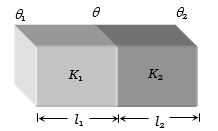
Two rods of same length and cross section are joined along the length. Thermal conductivities of first and second rod are ${K_1}\,\,{\rm{and}}\,\,{K_2}$. The temperature of the free ends of the first and second rods are maintained at ${\theta _1}\,\,{\rm{and }}{\theta _2}$ respectively. The temperature of the common junction is
  • A
    $\frac{{{\theta _1} + {\theta _2}}}{2}$
  • B
    $\frac{{{K_2}{K_2}}}{{{K_1} + {K_2}}}({\theta _1} + {\theta _2})$
  • $\frac{{{K_1}{\theta _1} + {K_2}{\theta _2}}}{{{K_1} + {K_2}}}$
  • D
    $\frac{{{K_2}{\theta _1} + {K_1}{\theta _2}}}{{{K_1} + {K_2}}}$
Answer

Correct option: C.
$\frac{{{K_1}{\theta _1} + {K_2}{\theta _2}}}{{{K_1} + {K_2}}}$
c
(c) At steady state, rate of heat flow for both blocks will be same i.e., $\frac{{{K_1}A({\theta _1} - \theta )}}{{{l_1}}} = \frac{{{K_2}A(\theta - {\theta _2})}}{{{l_2}}}$(given ${l_1} = {l_2}$)
$ \Rightarrow {K_1}A({\theta _1} - \theta ) = {K_2}A(\theta - {\theta _2})$ $ \Rightarrow \theta = \frac{{{K_1}{\theta _1} + {K_2}{\theta _2}}}{{{K_1} + {K_2}}}$

Need a full question paper?

Generate a complete, print-ready paper with questions like this in minutes — across 16+ boards, with answer keys.

Start Generating Free

Similar questions

A simple pendulum with bob of mass $m$ and length $x$ is held in position at an angle $\theta_1$ and then angle $\theta_2$ with the vertical. When released from these positions, speeds with which it passes the lowest positions are $v_1$ and $v_2$ respectively. Then, $\frac{v_1}{v_2}$ is .............
An ideal gas is expanded adiabatically at an initial temperature of $300 K$ so that its volume is doubled. The final temperature of the hydrogen gas is $(\gamma = 1.40)$
A uniform copper rod of length $50 \,cm$ and diameter $3.0 \,mm$ is kept on a frictionless horizontal surface at $20^{\circ} C$. The coefficient of linear expansion of copper is $2.0 \times 10^{-5} \,K ^{-1}$ and Young's modulus is $1.2 \times 10^{11} \,N / m ^2$. The copper rod is heated to $100^{\circ} C$, then the tension developed in the copper rod is .......... $\times 10^3 \,N$
A particle moves for $8\, seconds$. It first accelerates from rest and then retards to rest. If the retardation be $3\, times$ the acceleration, then time for which it accelerates will be 
A $2\, Kg$ block moving with $10\, m/s$ strikes a spring of constant $\pi ^2 N/m$ attached to $2\, Kg$ block at rest kept on a smooth floor. The time for which rear moving block remain in contact with spring will be ... $\sec$
A uniform rod $AB$ of weight $100\, N$ rests on a rough peg at $C$ and $a$ force $F$ acts at $A$ as shown in figure. If $BC = CM$ and tana $= 4/3$. The minimum coefficient of friction at $C$ is
Which of the following pairs may give equal numerical values of the temperature of a body?
The quality of the material which opposes the change in shape, volume or length is called
A particle of mass $m$ moving with velocity $u$ makes an elastic one dimensional collision with a stationary particle of mass $m$. They are in contact for a very short time $T$. Their force of interaction increases from zero to $F_0$ linearly in time $T/2$, and decreases linearly to zero in further time $T/2$. The magnitude of $F_0$ is
While walking on ice, one should take small steps to avoid slipping. This is because smaller steps ensure: