Question
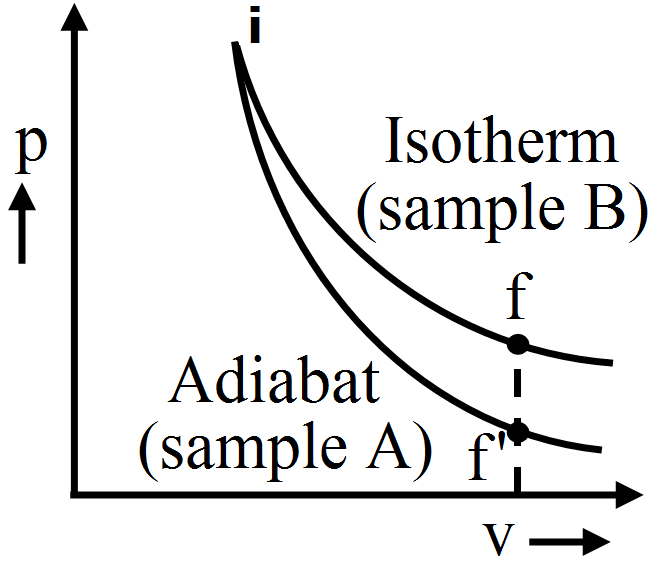
Two samples A and B are initially kept in the same state. Sample A is expanded through an adiabatic process and the sample B through an isothermal process. The final volumes of the samples are the same. The final pressures in A and B are pA and prespectively.
  1. pA > pB
  2. pA = pB
  3. pA < pB
  4. The relation between pA and pB cannot be deduced.
Answer

  1. pA < pB

Explanation:

Let the initial states of samples A and B be i and the final states of samples B and A be f and f', respectively. Let the final volumes of both be Vo. As sample A is expanded through an adiabatic process, its curve in the p-V diagram is steeper than that of sample B, which is expanded through an isothermal process. Therefore, from the p-V diagram, pA < pB.

Need a full question paper?

Generate a complete, print-ready paper with questions like this in minutes — across 16+ boards, with answer keys.

Start Generating Free

Similar questions

A 100 mH coil carries a current of 1 ampere. Energy stored in its magnetic field is

(a) 0.5 J

(b) 1 J

(c) 0.05 J 

(d) 0.1 J

If a copper rod carries a direct current, the magnetic field associated with the current will be:
The value of force along on a charged particle in electric tied is :
The time constant of an inductance coil is 2×10⁻³s. When a $90\Omega$ resistance is joined in series, the same constant becomes 0.5×10⁻³s. The inductance and resistance of the coil are

A sphere of radius R has a uniform distribution of electric charge in its volume. At a distance x from its centre, for x < R, the electric field is directly proportional to

(a)  

(b)  

(c) x  

(d)  

A beam consisting of protons and electrons moving at the same speed goes through a thin region in which there is a magnetic field perpendicular to the beam. The protons and the electrons:

In an hydrogen atom, the electron revolves around the nucleus in an orbit of radius 0.53 . Then the electrical potential produced by the nucleus at the position of the electron is

(a) – 13.6 V

(b) – 27.2 V

(c) 27.2 V  

(d) 13.6 V

Direction of the first secondary maximum in the Fraunhofer diffraction pattern at a single slit is given by (a is the width of the slit)

(a) asinθ = 

(b) acosθ = 

(c) asinθ = 

(d) asinθ =   

The wire wound resistor is also known as:

The structure of solid crystals is investigated by using

(a) Cosmic rays

(b) X-rays

(c) Infrared radiations

(d) γ -  rays