MCQ
Two similar coils are kept mutually perpendicular such that their centres coincide. At the centre, find the ratio of the magnetic field due to one coil and the resultant magnetic field by both coils, if the same current is  flown
  • $1: \sqrt 2$
  • B
    $1 : 2$
  • C
    $2 : 1$
  • D
    $\sqrt 3:1$ 

Answer

Correct option: A.
$1: \sqrt 2$
$1: \sqrt 2$

Need a full question paper?

Generate a complete, print-ready paper with questions like this in minutes — across 16+ boards, with answer keys.

Start Generating Free

Similar questions

Coulomb’s force between two stationery charges is also:
The energy of a charged capacitor resides in(a) The electric field only
 (b) The magnetic field only(d) Neither in electric nor magnetic field(d) Neither in electric nor magnetic field
   
   
The voltage gain of a triode depends upon(a) Filament voltage(b) Plate voltage(c) Plate resistance(d) Plate current
       
An electron is accelerated to 5 volt potential difference. The energy gained by the electron will be :
At ordinary temperatures, the electrical conductivity of semi conductors in mho/meter is in the range
Which one is not the property of charge?
The centre of mass of a system of particles is at the origin. It follows that:
  1. The number of particles to the right of the origin is equal to the number of particles to the left.
  2. The total mass of the particles to the right of the origin is same as the total mass to the left of the origin.
  3. The number of particles on X-axis should be equal to the number of particles on Y-axis.
  4. If there is a particle on the positive X-axis, there must be at least one particle on the negative X-axis.
  5. None.
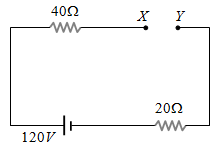
In the circuit shown, potential difference between $X$ and $Y$ will be
A body is rotating uniformly about a vertical axis fixed in an inertial frame. The resultant force on a particle of the body not on the axis is:
  1. Vertical.
  2. Horizontal and skew with the axis.
  3. Horizontal and intersecting the axis.
  4. None of these.
The maximum electric field that a dielectric medium can withstand without break-down is called its: