Question
Two simple harmonic motions are represented by:$\text{x}_1=10\sin\Big(4\pi\text{t}+\frac{\pi}{4}\Big)$
$\text{x}_2=5(\sin4\pi\text{t}+\sqrt{3}\cos4\pi\text{t})$
What is the ratio of the amplitudes?
Answer

$\text{x}_2=5\sin4\pi\text{t}+5\sqrt{3}\cos4\pi\text{t}$Amplitude of $\text{x}_2=\sqrt{5^2+(5\sqrt{3})^2}=10$
Since the $\sin\pi\text{t}$ and $\cos4\pi\text{t}$ functions are out ofphase by $\frac{\pi}{2}.$
Amplitude of $x_2 = 10$
$\therefore$ Ratio of amplitudes is $1 : 1$

Need a full question paper?

Generate a complete, print-ready paper with questions like this in minutes — across 16+ boards, with answer keys.

Start Generating Free

Similar questions

A sphere of mass 'm' moving with a velocity u hits another stationary sphere of same mass at rest. If e is the coefficient of restitution. Find the ratio of the velocities of two spheres after the collision.
Absolute zero temperature is not the temperature of zero energy. Explain.
In Exercises $3.13$ and $3.14$, we have carefully distinguished between average speed and magnitude of average velocity. No such distinction is necessary when we consider instantaneous speed and magnitude of velocity. The instantaneous speed is always equal to the magnitude of instantaneous velocity. Why?
A refrigerator has to transfer an average of 263J of heat per second from temperature -10°C to 25°C. Calculate the average power consumed assuming ideal reversible cycle and no other losses.
A glass marble slides from rest from the topmost point of a vertical circle of radius r along a smooth chord. Does the time of descent depend upon the chord chosen?
The displacement $($in metre$)$ of a particle moving along $x-$axis is given by $x = 18t + 5r^2$. Calculate:
  1. The instantaneous velocity at $t = 2s$.
  2. Average velocity between $t = 2s$ and $t = 3s$.
  3. Instantaneous acceleration.
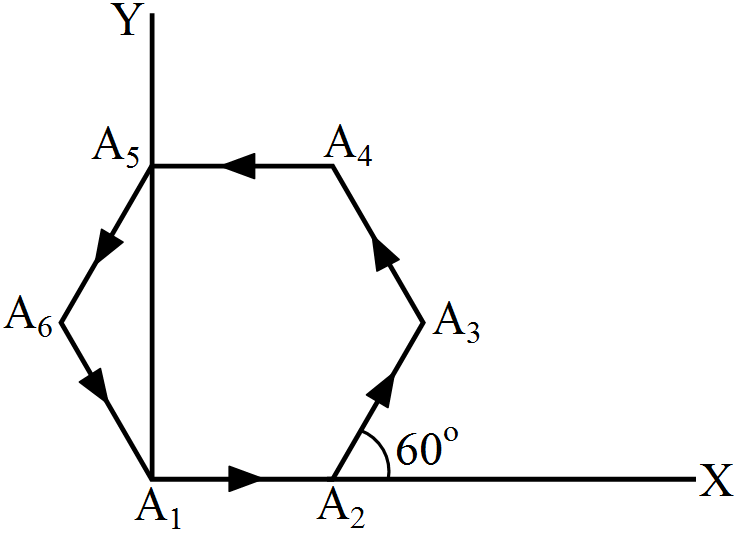
Let $A_1A_2A_3 A_4 A_5 A_6 A_1$ be a regular hexagon. Write the x-components of the vectors represented by the six sides taken in order. Use the fact that the resultant of these six vectors is zero, to prove that$\cos0+\cos\frac{\pi}{3}+\cos\frac{2\pi}{3}+\cos\frac{3\pi}{3}+\cos\frac{4\pi}{3}+\cos\frac{5\pi}{3}=0.$
Use the known cosine values to verify the result.
The centre of mass is defined as $\overrightarrow{\text{R}}=\frac{1}{\text{M}}\sum\limits_\text{i}\text{m}_\text{i}\overrightarrow{\text{r}_{\text{i}}}.$ Suppose we define "centre of charge" as $\overrightarrow{\text{R}}_\text{c}=\frac{1}{\text{Q}}\sum\limits_\text{i}\text{q}_\text{i}\overrightarrow{\text{r}_{\text{i}}}$ where $q_i$ represents the $i^{th}$ charge placed at $\overrightarrow{\text{r}_\text{i}}$ and Q is the total charge of the system.
  1. Can the centre of charge of a two-charge system be outside the line segment joining the charges?
  2. If all the charges of a system are in X-Y plane, is it necessary that the centre of charge be in X-Y plane?
  3. If all the charges of a system lie in a cube, is it necessary that the centre of charge be in the cube?
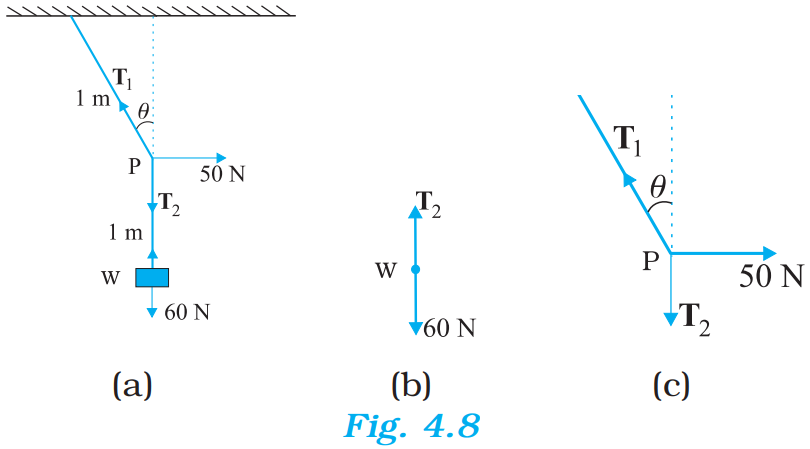
See Fig. $4.8.$ A mass of $6 \ kg$ is suspended by a rope of length $2 m$ from the ceiling. A force of $50 N$ in the horizontal direction is applied at the midpoint $P$ of the rope, as shown. What is the angle the rope makes with the vertical in equilibrium? $($Take $g=10 m s ^{-2} )$. Neglect the mass of the rope.
Image
The displacement of a particle having $\text{S.H.M}$. is $x = 10\sin\Big[10\pi\text{t}+\frac{\pi}{4}\Big]\text{m}.$
  1. Amplitude.
  2. Angular frequency.
  3. Epoch.
  4. Time period.
  5. Frequency.
  6. Maximum velocity.