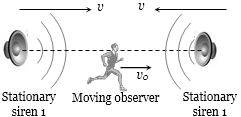
Two sirens situated one kilometer apart are producing sound of frequency $330 Hz$. An observer starts moving from one siren to the other with a speed of $2 m/s$. If the speed of sound be $330 m/s$, what will be the beat frequency heard by the observer
Diffcult


Download our appand get started for free
Experience the future of education. Simply download our apps or reach out to us for more information. Let's shape the future of learning together!No signup needed.*
Similar Questions
- 1View SolutionSound waves of wavelength greater than that of audible sound are called
- 2View SolutionWhen temperature increases, the frequency of a tuning fork
- 3If $n _{1}, n_{2}$ and $n _{3}$ are the fundamental frequencies of three segments into which a string is divided, then the original fundamental frequency $n$ of the string is given byView Solution
- 4In Melde's experiment, the string vibrates in $4$ loops when a $50 \,gram$ weight is placed in the pan of weight $15\, gram.$ To make the string to vibrates in $6$ loops the weight that has to be removed from the pan isView Solution
- 5Two tuning forks have frequencies $450\, Hz$ and $454\, Hz$ respectively. On sounding these forks together, the time interval between successive maximum intensities will be .... $sec$View Solution
- 6A cylindrical tube $(L = 120\,cm.)$ is resonant with a tuning fork of frequency $330\,Hz$. If it is filling by water then to get resonance minimum length of water column is ..... $cm$ $(V_{air} = 330\,m/s)$View Solution
- 7View SolutionIf we study the vibration of a pipe open at both ends, then the following statement is not true.
- 8When two sound sources of the same amplitude but of slightly different frequencies $v_1$ and $v_2$ are sounded simultaneously, the sound one hears has a frequency equal toView Solution
- 9$Assertion :$ For the formation of stationary waves the medium must be bounded having definite boundaries.View Solution
$Reason :$ In the stationary wave, some particles of the medium remain permanently at rest. - 10An observer moves towards a stationary source of sound, with a velocity one-fifth of the velocity of sound. What is the percentage increase in the apparent frequency ... $\%$View Solution