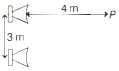
Two small identical speakers are connected in phase to the same source. The speakers are $3 \,m$ apart and at ear level. An observer stands at $P, 4 \,m$ in front of one speaker as shown alongside. The sound she hears is least intense when the wavelength is $\lambda_1$ and most intense when the wavelength is $\lambda_2$. Then, the possible values of $\lambda_1$ and $\lambda_2$ are
KVPY 2009, Diffcult
Download our app for free and get started
(c) Path difference of sounds from speakers $A$ and $B$ is $1 \,m (=5 \,m -4 \,m )$.
For least intense sound, $1 \,m$ can cause a destructive interference. So, path difference is an odd multiple of half wavelength.
$\Rightarrow \Delta L=(2 n+1) \frac{\lambda_1}{2}$
$\Rightarrow 1 \,m =\frac{\lambda_1, 3 \lambda_1, 5 \lambda_1}{2}, \frac{2}{2}, \text { etc. }$
Above condition is satisfied, when $\lambda_1=2 \,m$.
And for most intense sound, path difference of $1 m$ can cause a constructive interference. So, path difference must be a whole number multiple of one wavelength.
$\Rightarrow \Delta L=n \lambda_2$
$\Rightarrow 1 \,m =\lambda_2, 2 \lambda_2, 3 \lambda_2, \ldots, \text { etc. }$
Above condition is satisf ied with $\lambda_2=1 \,m$.
So, correct option is $(c)$.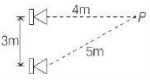

Download our appand get started for free
Experience the future of education. Simply download our apps or reach out to us for more information. Let's shape the future of learning together!No signup needed.*
Similar Questions
- 1$4.0 \,g$ of a gas occupies $22.4$ litres at $NTP.$ The specific heat capacity of the gas at constant volume is $5.0 \,\,J K^{-1} mol^{-1}$. If the speed of sound in this gas at $NTP$ is $952\, m s^{-1}$, then the heat capacity at constant pressure is .... $J K^{-1} mol^{-1}$ (Take gas constant $R = 8.3 \,\,J K^{-1} mol^{-1}$)View Solution
- 2The path Difference between the two waves ${y_1} = {a_1}\,\sin \,\left( {\omega t - \frac{{2\pi x}}{\lambda }} \right)$ and ${y_2} = {a_2}\,\cos \,\left( {\omega t - \frac{{2\pi x}}{\lambda } + \phi } \right)$ isView Solution
- 3An observer moves towards a stationary source of sound, with a velocity one-fifth of the velocity of sound. What is the percentage increase in the apparent frequency ... $\%$View Solution
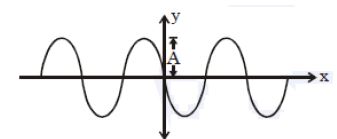
- 4A progressive wave travelling along the positive $x-$ direction is represented by $y(x, t) = A\,sin\,\left( {kx - \omega t + \phi } \right)$. Its snapshot at $t = 0$ is given in the figure For this wave, the phase $\phi $ isView Solution
- 5A pipe’s lower end is immersed in water such that the length of air column from the top open end has a certain length $25\,\, cm$. The speed of sound in air is $350 \,\,m/s$. The air column is found to resonate with a tuning fork of frequency $1750 \,\,Hz$. By what minimum distance should the pipe be raised in order to make the air column resonate again with the same tuning fork ... $cm$ ?View Solution
- 6The transverse displacement of a string (clamped at its both ends) is given byView Solution
$y(x,t)\, = \,0.6\,\sin \,\left( {\frac{{2\pi }}{3}x} \right)\,\cos \,(120\,\pi t)$
where $x$ and $y$ are in $metre$ and $t$ in $second$ . The length of the string is $1.5\,m$ and its mass is $3.0\times 10^{-2}\,kg$ the tension in the string will be .... $N$
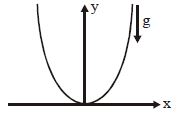
- 7A particle of mass $5 × 10^{-5}\ kg$ is placed at lowest point of smooth parabola $x^2$ = $40y$ ($x$ and $y$ in $m$) (in $rad/s$). If it is displaced slightly such that it is constrained to move along parabola, angular frequency of oscillation will be approximatelyView Solution
- 8The tension of a stretched string is increased by $69\%$. In order to keep its frequency of vibration constant, its length must be increased by ..... $\%$View Solution
- 9A tuning fork of frequency $340\,Hz$ resonates in the fundamental mode with an air column of length $125\,cm$ in a cylindrical tube closed at one end. When water is slowly poured in it, the minimum height of water required for observing resonance once again is________ $cm$View Solution
(Velocity of sound in air is $340\,ms ^{-1}$ )
- 10Two strings $X$ and $Y$ of a sitar produce a beat frequency $4 Hz$. When the tension of the string $Y$ is slightly increased the beat frequency is found to be $2 Hz.$ If the frequency of $X$ is $300 Hz,$ then the original frequency of $Y$ was .... $Hz$View Solution