MCQ
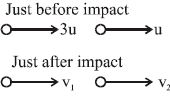
Two smooth objects with a coefficient of restitution $e,$ collide directly and bounce as shown. Newton's law of restitution gives
  • A
    $e \times 4u = v_2 + v_1$
  • B
    $e \times 2u = v_1 + v_2$
  • $e \times 2u = v_2 - v_1$
  • D
    it cannot be applied as the masses are not known

Answer

Correct option: C.
$e \times 2u = v_2 - v_1$
c
$H=20+15=35 \mathrm{m}$

${\mathrm{e}=\frac{\mathrm{v}_{2}-\mathrm{v}_{1}}{\mathrm{u}_{1}-\mathrm{u}_{2}}}$

${\mathrm{e}=\frac{\mathrm{v}_{2}-\mathrm{v}_{1}}{3 \mathrm{u}-\mathrm{u}_{1}}}$

${\mathrm{e}(2 \mathrm{u})=\mathrm{v}_{2}-\mathrm{v}_{1}}$

Need a full question paper?

Generate a complete, print-ready paper with questions like this in minutes — across 16+ boards, with answer keys.

Start Generating Free

Similar questions

In hydrogen atom, an electron is revolving in the orbit of radius $0.53\,{\mathop A\limits^o }$ with $6.6 \times {10^{15}}$ $rotations/second$. Magnetic field produced at the centre of the orbit is.......$wb/{m^2}$
A particle is projected from ground at an angle $\theta$ with horizontal with speed $u$. The ratio of radius of curvature of its trajectory at point of projection to radius of curvature at maximum height is ........
If the value of g at the surface of the earth is $9.8$ $m/{\sec ^2}$, then the value of g at a place $480\, km$ above the surface of the earth will be .......... $m/{\sec ^2}$. (Radius of the earth is $6400\, km$)   
Velocity of sound in air

$I.$ Increases with temperature

$II.$ Decreases with temperature

$III.$ Increase with pressure

$IV.$ Is independent of pressure

$V.$ Is independent of temperature

Choose the correct answer.

A current of $1.5\, {A}$ is flowing through a triangle, of side $9\, {cm}$ each. The magnetic field at the centroid of the triangle is

(Assume that the current is flowing in the clockwise direction.)

${T}_{0}$ is the time period of a simple pendulum at a place. If the length of the pendulum is reduced to $\frac{1}{16}$ times of its initial value, the modified time
A man drops a ball downside from the roof of a tower of height $400 m\,eters$. At the same time another ball is thrown upside with a velocity $50\, meter/sec$. from the surface of the tower, then they will meet at which height from the surface of the tower............$meters$
The nearest distance between two atoms in case of a $ bcc $ lattice is equal to
When $n$ vectors of different magnitudes are added, we get a null vector. Then the value of $n$ cannot be
The speed at which the image of the luminous point object is moving, if the luminous point object is moving at speed $v_0$ towards a spherical mirror, along its axis is (Given, $r =$ radius of curvature $u =$ object distance)