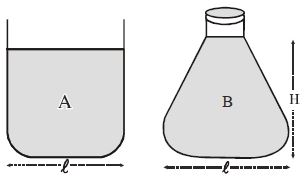
Two solids $A$ and $ B$ float in water. It is observed that $A$ floats with $\frac{1}{2}$ of its body immersed in water and $ B$ floats with $\frac{1}{4}$ of its volume above the water level. The ratio of the density of $ A$ to that of $B$ is
Medium
Download our app for free and get started
(b)Upthrust = weight of body
For $A$ , $\frac{{{V_A}}}{2} \times {\rho _W} \times g = {V_A} \times {\rho _A} \times g \Rightarrow {\rho _A} = \frac{{{\rho _W}}}{2}$
For $ B$, $\frac{3}{4}{V_B} \times {\rho _W} \times g = {V_B} \times {\rho _B} \times g \Rightarrow {\rho _B} = \frac{3}{4}{\rho _W}$
(Since 1/4 of volume of B is above the water surface)
$\frac{{{\rho _A}}}{{{\rho _B}}} = \frac{{{\rho _W}/2}}{{3/4\;{\rho _W}}} = \frac{2}{3}$
For $A$ , $\frac{{{V_A}}}{2} \times {\rho _W} \times g = {V_A} \times {\rho _A} \times g \Rightarrow {\rho _A} = \frac{{{\rho _W}}}{2}$
For $ B$, $\frac{3}{4}{V_B} \times {\rho _W} \times g = {V_B} \times {\rho _B} \times g \Rightarrow {\rho _B} = \frac{3}{4}{\rho _W}$
(Since 1/4 of volume of B is above the water surface)
$\frac{{{\rho _A}}}{{{\rho _B}}} = \frac{{{\rho _W}/2}}{{3/4\;{\rho _W}}} = \frac{2}{3}$

Download our appand get started for free
Experience the future of education. Simply download our apps or reach out to us for more information. Let's shape the future of learning together!No signup needed.*
Similar Questions
- 1$Assertion :$ Falling raindrops acquire a terminal velocity.View Solution
$Reason :$ A constant force in the direction of motion and a velocity dependent force opposite to the direction of motion, always result in the acquisition of terminal velocity. - 2A large drop of oil (density $0.8\,g / cm ^3$ and viscosity $\eta_0$) floats up through a column of another liquid (density $1.2\,g / cm ^3$ and viscosity $\eta_L$ ). Assuming that the two liquids do not mix, the velocity with which the oil drop rises will depend on.View Solution
- 3A cylindrical vessel filled with water upto height of $H$ stands on a horizontal plane. The side wall of the vessel has a plugged circular hole touching the bottom. The coefficient of friction between the bottom of vessel and plane is $\mu$ and total mass of water plus vessel is $M$. What should be minimum diameter of hole so that the vessel begins to move on the floor if plug is removed (here density of water is $\rho$ )View Solution
- 4Two vessels $A$ and $B$ have the same base area and contain water to the same height, but the mass of water in $A$ is four times that in $B$. The ratio of the liquid thrust at the base of $A$ to that at the base of $B$ isView Solution
- 5Small water droplets of radius $0.01 \mathrm{~mm}$ are formed in the upper atmosphere and falling with a terminal velocity of $10 \mathrm{~cm} / \mathrm{s}$. Due to condensation, if $8 \mathrm{such}$ droplets are coalesced and formed a larger drop, the new terminal velocity will be ........... $\mathrm{cm} / \mathrm{s}$.View Solution
- 6According to Bernoulli's equation $\frac{P}{{\rho g}} + h + \frac{1}{2}\,\frac{{{v^2}}}{g} = {\rm{constant}}$ The terms $A, B$ and $ C$ are generally called respectively:View Solution
- 7A $U-$ tube containing a liquid moves with a horizontal acceleration a along a direction joining the two vertical limbs. The separation between these limbs is $d$ . The difference in their liquid levels isView Solution
- 8A capillary tube is attached horizontally to a constant head arrangement. If the radius of the capillary tube is increased by $10\%$ then the rate of flow of liquid will change nearly by ......... $\%$View Solution
- 9In an experiment, a small steel ball falls through a Iiquid at a constant speed of $10\, cm/s$. If the steel ball is pulled upward with a force equal to twice its effective weight, how fast will it move upward ? ......... $cm/s$View Solution
- 10Blood velocity: The flow of blood in a large artery of an anesthetised dog is diverted through a Venturi meter. The wider part of the meter has a crosssectional area equal to that of the artery. $A = 8\; mm^2$. The narrower part has an area $a = 4 \;mm^2$. The pressure drop in the artery is $24\; Pa$. What is the speed (in $m/s$) of the blood in the artery?View Solution