MCQ
Two sound waves (expressed in $CGS$ units) given by ${y_1} = 0.3\sin \frac{{2\pi }}{\lambda }(vt - x)$ and ${y_2} = 0.4\sin \frac{{2\pi }}{\lambda }(vt - x + \theta )$ interfere. The resultant amplitude at a place where phase difference is $\pi /2$ will be .... $ cm$
  • A
    $0.7$
  • B
    $0.1$
  • $0.5$
  • D
    $\frac{1}{{10}}\sqrt 7 $

Answer

Correct option: C.
$0.5$
c
(c) Resultant amplitude = $\sqrt {a_1^2 + a_2^2 + 2{a_1}{a_2}\cos \phi } $

= $\sqrt {{{0.3}^2} + {{0.4}^2} + 2 \times 0.3 \times 0.4 \times \cos \frac{\pi }{2}} $= $0.5\,\,cm$

Need a full question paper?

Generate a complete, print-ready paper with questions like this in minutes — across 16+ boards, with answer keys.

Start Generating Free

Similar questions

A uniform wire of length $L$ and mass $M$ is stretched between two fixed points, keeping tension $F$. A sound of frequency $m$ is impressed on it. Then the maximum vibrational energy is existing in the  wire when $\mu $ =
If the change in the value of $‘g’$ at a height $h$ above the surface of the earth is the same as at a depth $x$ below it, then (both $x$ and $h$ being much smaller than the radius of the earth)
A particle of mass $5 × 10^{-5}\ kg$ is placed at lowest point of smooth parabola $x^2 = 40y$ ( $x$ and $y$ in $m$ ). If it is displaced slightly such that it is constrained to move along parabola, angular frequency of oscillation (in $rad/s$) will be approximately:-
A person running horizontally observes that rain is falling on his head vertically with speed $10\,m/s$. He stops and observes that rain is coming at an angle $30^o$ with vertical. Find the speed of rain w.r.t. ground
A particle moves in a circular path with a uniform speed. Its motion is:
  1. Periodic.
  2. Oscillatory.
  3. Simple harmonic.
  4. Angular simple harmonic.
Two projectiles $A$ and $B$ are thrown with the same speed but angles are $40^{\circ}$ and $50^{\circ}$ with the horizontal. Then
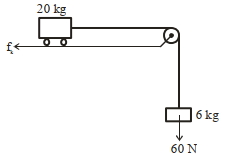
Consider a block and trolley system as shown in figure. If the coefficient of kinetic friction between the trolley and the surface is $0.04$ , the acceleration of the system in $\mathrm{ms}^{-2}$ is :

(Consider that the string is massless and unstretchable and the pulley is also massless and frictionless):

What should be the velocity of earth due to rotation about its own axis so that the weight at equator become $3/5$ of initial value. Radius of earth on equator is $ 6400\, km$
In a two dimensional motion, instantaneous speed v0 is a positive constant. Then which of the following are necessarily true?
The density of a newly discovered planet is twice that of earth. The acceleration due to gravity at the surface of the planet is equal to that at the surface of the earth. If the radius of the earth is surface of the earth. If the radius of the earth is R, the radius of the planet would be: