MCQ
Two sound waves having a phase difference of $60°$ have path difference of
  • A
    $2 \lambda$
  • B
    $\lambda /2$
  • $\lambda /6$
  • D
    $\lambda /3$

Answer

Correct option: C.
$\lambda /6$
c
(c) Path difference $\Delta = \frac{\lambda }{{2\pi }} \times \phi = \frac{\lambda }{{2\pi }} \times \frac{\pi }{3} = \frac{\lambda }{6}$

Need a full question paper?

Generate a complete, print-ready paper with questions like this in minutes — across 16+ boards, with answer keys.
Start Generating Free

Similar questions

Which of the following quantities do not change when a resistor connected to a battery is heated due to the current?
A particle $P$ is moving in a circle of radius $'a'$ with a uniform speed $v$. $C$ is the centre of the circle and $AB$ is a diameter. When passing through $B$ the angular velocity of $P$ about $A$ and $C$ are in the ratio
A solid floats in a liquid in a partially dipped position.
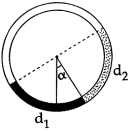
There is a circular tube in a vertical plane. Two liquids which do not mix and of densities $d_1$ and $d_2$ are filled in the tube. Each liquid subtends $90^o$ angle at centre. Radius joining their interface makes an angle $\alpha$ with vertical. Ratio $\frac{{{d_1}}}{{{d_2}}}$ is
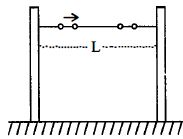
A large number $(n)$ of identical beads, each of mass $m$ and radius $r$ are strung on a thin smooth rigid horizontal rod of length $L\, (L >> r)$ and are at rest at random positions. The rod is mounted between two rigid supports (see figure) . If one of the beads is now given a speed $v$, the average force experienced by each support after a long time is (assume all collisions are elastic)
A particle is projected with velocity ${\upsilon _0}$ along $x - axis$. The deceleration on the particle is proportional to the square of the distance from the origin i.e., $a = \alpha {x^2}.$ The distance at which the particle stops is
Mechanical equivalent of heat is equal to the amount of:
A body of length 1m having cross sectional area $0.75\;m^2$ has heat flow through it at the rate of $ 6000\; Joule/sec$ . Then find the temperature difference if $K = 200\;J{m^{ - 1}}{K^{ - 1}}$ ...... $^oC$
$A$ particle is moving in a circular orbit of radius $r_1$ with an angular velocity $\omega_1$ . It jumps to another circular orbit of radius $r_2$ and attains an angular velocity $\omega_2$ . If $r_2 = 0.5\, r_1$ and assuming that no external torque is applied to the system, then the angular velocity $\omega_2$, is given by :
A cylinder with a movable piston contains $3\,moles$ of hydrogen at standard temperature and pressure. The walls of the cylinder are made of a heat insulator, and the piston is insulated by having a pile of sand on it. By what factor does the pressure of the gas increases if the gas is compressed to half its original volume?