MCQ
Two sound waves having a phase difference of $60°$ have path difference of
  • A
    $2 \lambda$
  • B
    $\lambda /2$
  • $\lambda /6$
  • D
    $\lambda /3$

Answer

Correct option: C.
$\lambda /6$
c
(c) Path difference $\Delta = \frac{\lambda }{{2\pi }} \times \phi = \frac{\lambda }{{2\pi }} \times \frac{\pi }{3} = \frac{\lambda }{6}$

Need a full question paper?

Generate a complete, print-ready paper with questions like this in minutes — across 16+ boards, with answer keys.
Start Generating Free

Similar questions

The amplitude and the time period in a $S.H.M.$ is $0.5 \,cm$ and $0.4 \,sec$ respectively. If the initial phase is $\pi /2$ radian, then the equation of $S.H.M.$ will be
A solid sphere, a hollow sphere and and a ring are released from top of an inclined plane (frictionless) so that they slid down the plane. Then maximum acceleration down the plane is for (no rolling)
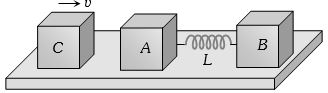
Two blocks $A$ and $B$ each of mass m are connected by a massless spring of natural length L and spring constant $K$. The blocks are initially resting on a smooth horizontal floor with the spring at its natural length as shown in figure. A third identical block $C$ also of mass $m$ moves on the floor with a speed $v$ along the line joining $A$ and $B$ and collides with $A$. Then
Which of the following cylindrical rods will conduct most heat, when their ends are maintained at the same steady temperature
A tuning fork vibrating with a sonometer having $20\,cm$ wire produces $5$ beats per sec. The beat frequency does not change if the length of the wire is changed to $21\,cm$. The frequency of the tuning fork must be ..... $Hz$
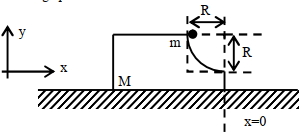
A block of mass $M$ has a circular cut with a frictionless surface as shown. The block rests on the horizontal frictionless surface of a fixed table. Initially the right edge of the block is at $x=0$, in a co-ordinate system fixed to the table. A point mass $m$ is released from rest at the topmost point of the path as shown and it slides down. When the mass loses contact with the block, its position is $\mathrm{x}$ and the velocity is $\mathrm{v}$. At that instant, which of the following options is/are correct?

(image)

$[A]$ The $x$ component of displacement of the center of mass of the block $M$ is : $-\frac{m R}{M+m}$.

[$B$] The position of the point mass is : $x=-\sqrt{2} \frac{\mathrm{mR}}{\mathrm{M}+\mathrm{m}}$.

[$C$] The velocity of the point mass $m$ is : $v=\sqrt{\frac{2 g R}{1+\frac{m}{M}}}$.

[$D$] The velocity of the block $M$ is: $V=-\frac{m}{M} \sqrt{2 g R}$.
The rate of cooling due to conduction, convection, and radiation combined, is proportional to the difference in temperature, for:
A force $\vec F\, = \,(2\hat i\, - \,\hat j\, + 3\hat k)$ is acting at a point $(-1, 2, -3).$ Find its torque about the origin
When two bodies collide elastically, then
A wheel of radius $R$ is trapped in a mud pit and spinning. As the wheel is spinning, it splashes mud blobs with initial speed $u$ from various points on its circumference. The maximum height from the centre of the wheel, to which a mud blob can reach is