MCQ
Two sources are called coherent if they produce waves:
  • A
    Of equal wavelength.
  • B
    Of equal velocity.
  • C
    Having same shape of wavefront.
  • Having a constant phase difference.

Answer

Correct option: D.
Having a constant phase difference.

For light waves emitted by two sources of light to remain coherent, the initial phase difference between waves should remain constant in time. If the phase difference changes continuously or randomly with time, then the sources are incoherent.

Need a full question paper?

Generate a complete, print-ready paper with questions like this in minutes — across 16+ boards, with answer keys.
Start Generating Free

Similar questions

Peak value of applied alternating voltage in a LR cir- cuit is 5 V. If magnitude of maximum voltage across the ends of resistor is 3 V. then maximum value of voltage across the inductor is
If a current is passed through a spring then the spring will
Two wires of the same material are given. The first wire is twice as long as the second and has twice the diameter of the second. The resistance of the first will be
Car $B$ overtakes another car $A$ at a relative speed of $40\, ms^{-1}$. How fast will the image of car ${B}$ appear to move in the mirror of focal length $10\, cm$ fitted in car ${A}$, when the car ${B}$ is $1.9\, m$ away from the car ${A}$ ? (In $ms^{-1}$)
When the light source is kept 20 cm away from a photo cell, stopping potential 0.6 V is obtained. When source is kept 40 cm away, the stopping potential will be
A $40\, \mu F$ capacitor is connected to a $200\, V , 50 \,Hz$ ac supply. The rms value of the current in the circult is, nearly $.......A$
A capacitor is discharging through a resistor $R$. Consider in time $t _{1}$, the energy stored in the capacitor reduces to half of its initial value and in time $t_{2}$, the charge stored reduces to one eighth of its initial value. The ratio $t_{1} / t_{2}$ will be ................
For principal quantum number n = 3, the possible values of orbital quantum number ‘l’ are
The figure shows a process on a gas in which pressure and volume both change. The molar heat capacity for this process is $C$.
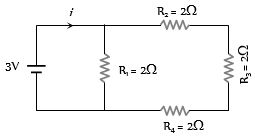
What is the current $(i)$ in the circuit as shown in figure ........... $A$