Question
Two sources give interference pattern which is observed on a screen, D distance apart from the sources. The fringe width is 2w. If the distance D is now doubled, the fringe width will(a) Become w/2(b) Remain the same(c) Become w(d) Become 4w
       

Answer

(d) Become 4w

Need a full question paper?

Generate a complete, print-ready paper with questions like this in minutes — across 16+ boards, with answer keys.

Start Generating Free

Similar questions

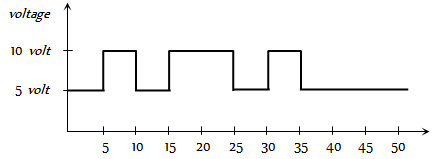
In a negative logic the following wave form corresponds to the
The matter-wave picture of electromagnetic wave/radiation elegantly incorporated the:
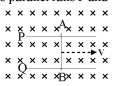
According to the figure, a conducting wire AB (length $l)$ is moving with a velocity v on two parallel rails P and Q. A uniform magnetic field is applied normally inwards to the plane of rails. Essential force needed to keep the velocity of the bar constant is:
Image
In Young's double slit experiment, if one of the slit is closed fully, then in the interference pattern(a) A bright slit will be observed, no interference pattern will exist(b) The bright fringes will become more bright(c) The bright fringes will become fainter(d) None of the above


In a PN-junction diode not connected to any circuit (a) The potential is the same everywhere(b) The P-type is a higher potential than the N-type side(c) There is an electric field at the junction directed from the N- type side to the P- type side(d) There is an electric field at the junction directed from the P-type side to the N-type side


A thin oil layer floats on water. A ray of light making an angle of incidence of $40^\circ$ shines on oil layer. The angle of refraction of light ray in water  is $\left(\mu_{\text{oil}}=1.45, \mu_{\text{water}}=1.33\right)$
The collector plate in an experiment on photoelectric effect is kept vertically above the emitter plate. Light source is put on and a saturation photocurrent is recorded. An electric field is switched on which has a vertically downward direction.
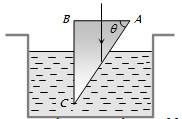
A glass prism $(\mu = 1.5)$ is dipped in water $(\mu = 4/3)$ as shown in figure. A light ray is incident normally on the surface $AB.$ It reaches the surface $BC$ after totally reflected, if
The wavefronts of light coming from a distant source of unknown shape are nearly:
If an electric current is passed through a nerve of a man, then man          (a) Begins to laugh(b) Begins to weep(c) Is excited(d) Becomes insensitive to pain