MCQ
Two sources of sound $A$ and $B$ produces the wave of $350 Hz$, they vibrate in the same phase. The particle $P$ is vibrating under the influence of these two waves, if the amplitudes at the point $P$ produced by the two waves is $0.3 mm$ and $0.4 mm,$ then the resultant amplitude of the point $P$ will be when $AP -BP = 25 cm$ and the velocity of sound is $350 m/sec$  .... $mm$
  • A
    $0.7$
  • B
    $0.1$
  • C
    $0.2$
  • $0.5$

Answer

Correct option: D.
$0.5$
d
(d) $\lambda = \frac{v}{n} = \frac{{350}}{{350}} = 1\,m=100 cm$

Also path difference $(\Delta x)$ between the waves at the point of observation is $AP - BP = 25cm$.

Hence

==> $\Delta \phi  = \frac{{2\pi }}{\lambda }(\Delta x) = \frac{{2\pi }}{1} \times \left( {\frac{{25}}{{100}}} \right) = \frac{\pi }{2}$

==> $ A = \sqrt {{{({a_1})}^2} + {{({a_2})}^2}}   =  \sqrt {{{(0.3)}^2} + {{(0.4)}^2}}  = 0.5  mm$

Need a full question paper?

Generate a complete, print-ready paper with questions like this in minutes — across 16+ boards, with answer keys.

Start Generating Free

Similar questions

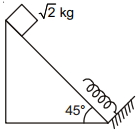
A block of mass $\sqrt{2}\,kg$ is released from the top of an inclined smooth surface as shown in figure. If spring constant of spring is $100\,N / m$ and block comes to rest after compressing the spring by $1 \,m$, then the distance travelled by block before it comes to rest is ......... $m$
A body of mass $1\,kg$ is projected with velocity $50\,m / s$ at an angle of $30^{\circ}$ with the horizontal. At the highest point of its path a force $10\,N$ starts acting on body for $5\,s$ vertically upward besides gravitational force, what is horizontal range of the body? $\left(g=10\,m/s^2\right)$
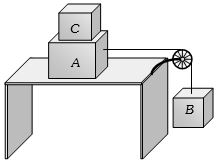
Two masses $A$ and $B$ of $10\, kg$ and $5 \,kg$ respectively are connected with a string passing over a frictionless pulley fixed at the corner of a table as shown. The coefficient of static friction of $A$ with table is $0.2$. The minimum mass of $C$ that may be placed on $A$ to prevent it from moving is ........ $kg$
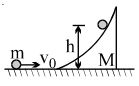
A particle of mass $m$ moving horizontally with $v_0$ strikes $a$ smooth wedge of mass $M$, as shown in figure. After collision, the ball starts moving up the inclined face of the wedge and rises to $a$ height $h$. When the particle has risen to $a$ height $h$ on the wedge, then choose the correct alternative $(s)$
$8$ mercury drops coalesce to form one mercury drop, the energy changes by a factor of
Cofficient of performance of refigerator is
The fundamental physical quantities that have same dimensions in the dimensional formulae of torque and angular momentum are
A positively charged particle projected towards east is deflected towards north by a magnetic field. The field may be:
A $^{238}U$ nucleus decays by emitting an $\alpha$ particle of speed $v\,m{s^{ - 1}}$. The recoil velocity of the residual nucleus is (in $m{s^{ - 1}}$)
A very large block of ice of the size of a volleyball court and of uniform thickness of $8 \,m$ is floating on water. A person standing near its edge wishes to fetch a bucketful of water using a rope. The smallest length of rope required for this is about ............... $m$