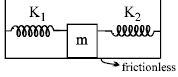
Two springs with negligible masses and force constant of $K_1 = 200\, Nm^{-1}$ and $K_2 = 160\, Nm^{-1}$ are attached to the block of mass $m = 10\, kg$ as shown in the figure. Initially the block is at rest, at the equilibrium position in which both springs are neither stretched nor compressed. At time $t = 0,$ a sharp impulse of $50\, Ns$ is given to the block with a hammer.
Diffcult
Download our app for free and get started

Download our appand get started for free
Experience the future of education. Simply download our apps or reach out to us for more information. Let's shape the future of learning together!No signup needed.*
Similar Questions
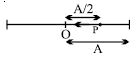
- 1A particle starts from a point $P$ at a distance of $A/2$ from the mean position $O\, \&$ travels towards left as shown in the figure. If the time period of $SHM,$ executed about $O$ is $T$ and amplitude $A$ then the equation of motion of particle is :View Solution
- 2A particle executing a simple harmonic motion of period $2\ s$ . When it is at its extreme displacement from its mean position, it receives an additional energy equal to what it had in its mean position. Due to this , in its subsequent motion,View Solution
- 3A vertical mass spring system executes simple harmonic oscillations with a period of $2\,s$. A quantity of this system which exhibits simple harmonic variation with a period of $1\, sec$ isView Solution
- 4The equation of $SHM$ of a particle is given asView Solution
$2\,\frac{{{d^2}x}}{{d{t^2}}} + 32x = 0$
where $x$ is the displacement from the mean position of rest. The period of its oscillation (in seconds) is
- 5The total energy of the body executing $S.H.M.$ is $E$. Then the kinetic energy when the displacement is half of the amplitude, isView Solution
- 6A particle moves on $x-$ axis according to the equation $x = x_0\,\,sin^2\,\omega t,$ the motion is simple harmonicView Solution
- 7A man is swinging on a swing made of $2$ ropes of equal length $L$ and in direction perpendicular to the plane of paper. The time period of the small oscillations about the mean position isView Solution

- 8If the time period of a two meter long simple pendulum is $2\, s$, the acceleration due to gravity at the place where pendulum is executing $S.H.M.$ isView Solution
- 9The angular velocity and the amplitude of a simple pendulum is $\omega $ and $a$ respectively. At a displacement $X$ from the mean position if its kinetic energy is $T$ and potential energy is $V$, then the ratio of $T$ to $V$ isView Solution
- 10A particle of mass $m$ performs $SHM$ along a straight line with frequency $f$ and amplitude $A.$View Solution