Question
Two statements are given-one labelled Assertion (A) and the other labelled Reason (R). Select the correct answer to these questions from the codes (a), (b), (c) and (d) as given below.
  1. Both A and R are true and R is the correct explanation of A.
  2. Both A and R are true but R is not the correct explanation of A.
  3. A is true but R is false.
  4. A is false and R is also false.
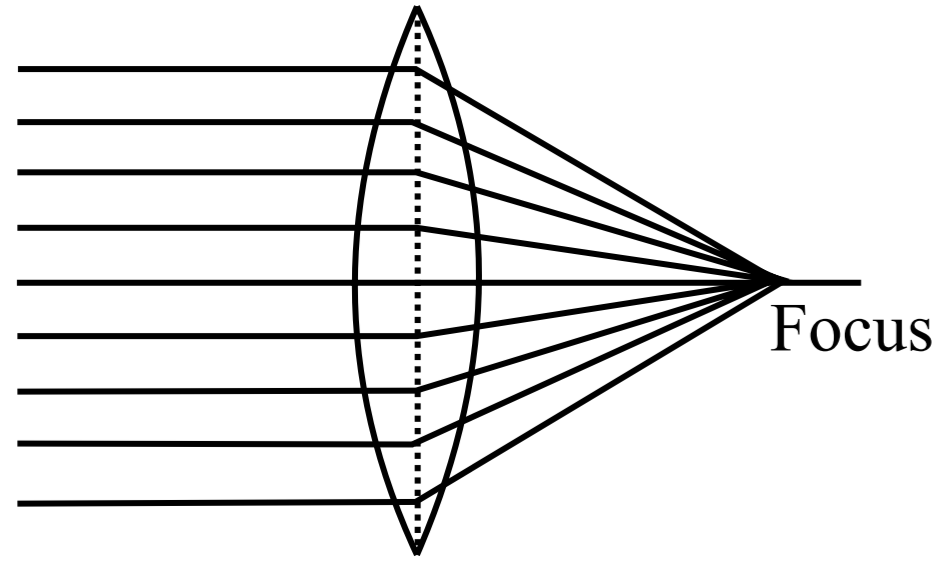
Assertion: The illuminance of an image produced by a convex lens is greater in the middle and less towards the edges.
Reason: The middle part of image is fanned by undeflected rays while outer part by inclined rays.
Answer

  1. Both A and R are true and R is the correct explanation of A.

Explanation:

Image formed by convex lens,

Need a full question paper?

Generate a complete, print-ready paper with questions like this in minutes — across 16+ boards, with answer keys.

Start Generating Free

Similar questions

Two statements are given-one labelled Assertion (A) and the other labelled Reason (R). Select the correct answer to these questions from the codes (a), (b), (c) and (d) as given below.
  1. Both A and R are true and R is the correct explanation of A.
  2. Both A and R are true but R is not the correct explanation of A.
  3. A is true but R is false.
  4. A is false and R is also false.
Assertion: The minimum distance between an object and its real image formed by a convex lens is 2f.
Reason: The distance between an object and its real image is minimum when its magnification is two.
For two statements are given-one labelled Assertion (A) and the other labelled Reason (R). Select the correct answer to these questions from the codes (a), (b), (c) and (d) as given below.
  1. Both A and R are true, and R is the correct explanation of A.
  2. Both A and R are true, but R is not the correct explanation of A.
  3. A is true but R is false.
  4. A is false and R is also false.
Assertion (A): Charging is due to transfer of electrons.
Reason (R): Mass of a body decreases slightly when it is negatively charged.
For two statements are given-one labelled Assertion (A) and the other labelled Reason (R). Select the correct answer to these questions from the codes (a), (b), (c) and (d) as given below.
  1. Both A and R are true, and R is the correct explanation of A.
  2. Both A and R are true, but R is not the correct explanation of A.
  3. A is true but R is false.
  4. A is false and R is also false.
Assertion (A): ln electrostatics, electric lines of force can never be closed loops, as a line can never start and end on the same charge.
Reason (R): The number of electric lines of force originating or terminating on a charge is proportional to the magnitude of charge.
Directions: In the following questions, the Assertions (A) and Reason(s) (R) have been put forward. Read both the statements carefully and choose the correct alternative from the following:
Assertion: A magnet remains stable, If it aligns itself with the field
Reason: The P.E. of a bar magnet is minimum, if it is parallel to magnetic field.
  1. Both A and R are true and R is the correct explanation of A.
  2. Both A and R are true and R is not correct explanation of A.
  3. A is true, But R is false.
  4. A is false, But R is true.
Two statements are given-one labelled Assertion (A) and the other labelled Reason (R). Select the correct answer to these questions from thecodes(a), (b), (c) and (d) as given below.
  1. Both A and R are true and R is the correct explanation of A.
  2. Both A and R are true but R is not the correct explanation of A.
  3. A is true but R is false.
  4. A is false and R is also false.
Assertion: The ratio of free electrons to holes in intrinsic semiconductor is greater than one.
Reason: The electrons are lighter particles and holes are heavy particles.
For question two statements are given-one labelled Assertion (A) and the other labelled Reason (R). Select the correct answer to these questions from the codes (a), (b), (c) and (d) as given below.
  1. Both A and R are true, and R is the correct explanation of A.
  2. Both A and R are true, but R is NOT the correct explanation of A.
  3. A is true, but R is false.
  4. A is false and R is also false.
Assertion (A): According to classical theory, the proposed path of an electron in Rutherford atom model will be circular.
Reason (R): According to electromagnetic theory an accelerated particle continuously emits radiation
For question two statements are given-one labelled Assertion (A) and the other labelled Reason (R). Select the correct answer to these questions from the codes (a), (b), (c) and (d) as given below.
  1. Both A and R are true and R is the correct explanation of A.
  2. Both A and R are true but R is NOT the correct explanation of A.
  3. A is true but R is false.
  4. A is false and R is also false.
Assertion (A): In Young's experiment the fringe width is directly proportional to wavelength of the source used.
Reason (R): When a thin transparent sheet is placed in front of both the slits of Young's experiment, the fringe width will increase.
Two statements are given-one labelled Assertion(A) and the other labelled Reason (R). Select the correct answer to these questions from the codes(a), (b), (c) and (d) as given below.
  1. Both A and R are true and R is the correct explanation of A.
  2. Both A and R are true but R is NOT the correct explanation of A.
  3. A is true but R is false.
  4. A is false and R is also false.
Assertion (A): A clinic lines on the magnetic map represents lines of equal dip.
Reason (R): When the horizontal and vertical components of the earth's magnetic field are equal, the angle of dip is 60º.
Directions: In the following questions, the Assertions (A) and Reason(s) (R) have been put forward. Read both the statements carefully and choose the correct alternative from the following:
Assertion: χ - T graph for a diamagnetic material is a straight line parallel to T axis.
Reason: This is because susceptibility of a diamagnetic material is not affected by temperature
  1. Both Assertion and Reason are correct and Reason is the correct explanation for Assertion.
  2. Both Assertion and Reason are correct but Reason is not the correct explanation for Assertion.
  3. Assertion is correct but Reason is incorrect.
  4. Both Assertion and Reason are incorrect.
For two statements are given-one labelled Assertion (A) and the other labelled Reason (R). Select the correct answer to these questions from the codes (a), (b), (c) and (d) as given below.
  1. Both A and R are true, and R is the correct explanation of A.
  2. Both A and R are true, but R is not the correct explanation of A.
  3. A is true, but R is false.
  4. A is false, and R is also false.
Assertion (A): A capacitor can be broken by placing large amount of charge on it.
Reason (R): After breakage potential, the capacitor is destroyed.