Question
Two statements are given-one labelled Assertion (A) and the other labelled Reason (R). Select the correct answer to these questions from the codes (a), (b), (c) and (d) as given below.
  1. Both A and R are true and R is the correct explanation of A.
  2. Both A and R are true but R is not the correct explanation of A.
  3. A is true but R is false.
  4. A is false and R is also false.
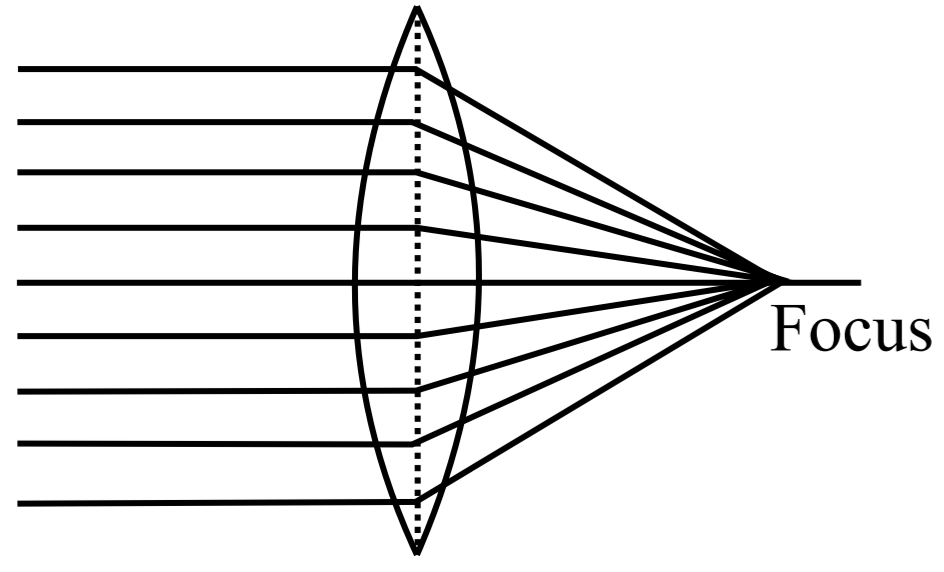
Assertion: The illuminance of an image produced by a convex lens is greater in the middle and less towards the edges.
Reason: The middle part of image is fanned by undeflected rays while outer part by inclined rays.
Answer

  1. Both A and R are true and R is the correct explanation of A.
Explanation:

Image formed by convex lens,

Need a full question paper?

Generate a complete, print-ready paper with questions like this in minutes — across 16+ boards, with answer keys.

Start Generating Free

Similar questions

Two statements are given-one labelled Assertion (A) and the other labelled Reason (R). Select the correct answer to these questions from the codes (a), (b), (c) and (d) as given below.
  1. Both A and R are true and R is the correct explanation of A.
  2. Both A and R are true but R is not the correct explanation of A.
  3. A is true but R is false.
  4. A is false and R is also false.
Assertion: Infrared waves sometimes referred as heat waves.
Reason: Infrared waves heat up the earth surface.
Directions: In the following questions, the Assertions (A) and Reason(s) (R) have been put forward. Read both the statements carefully and choose the correct alternative from the following:
Assertion: To protect any instrument from external magnetic field, it is put inside an iron box
Reason: Iron is a ferromagnetic substance
  1. Both A and R are true and R is the correct explanation of A.
  2. Both A and R are true and R is not correct explanation of A.
  3. A is true, But R is false.
  4. A is false, But R is true.
Two statements are given-one labelled Assertion (A) and the other labelled Reason (R). Select the correct answer to these questions from the codes (a), (b), (c) and (d) as given below.
  1. Both A and R are true and R is the correct explanation of A.
  2. Both A and R are true but R is NOT the correct explanation of A.
  3. A is true but R is false.
  4. A is false and R is also false.
Assertion (A): When the observation point lies along the length of the current element, magnetic field is zero.
Reason (R): Magnetic field close to current element is zero.
For two statements are given-one labelled Assertion (A) and the other labelled Reason (R). Select the correct answer to these questions from the codes (a), (b), (c) and (d) as given below.
  1. Both A and R are true and R is the correct explanation of A.
  2. Both A and R are true but R is not the correct explanation of A.
  3. A is true but R is false.
  4. A is false and R is also false.
Assertion: The alternating current lags behind the e.m.f. by a phase angle of $\frac{\pi}{2}$ when A.C. flows through an inductor.
Reason: The inductive reactance increases as the frequency of A. C. source decreases.
Two statements are given-one labelled Assertion(A) and the other labelled Reason (R). Select the correct answer to these questions from the codes(a), (b), (c) and (d) as given below.
  1. Both A and R are true and R is the correct explanation of A.
  2. Both A and R are true but R is NOT the correct explanation of A.
  3. A is true but R is false.
  4. A is false and R is also false.
Assertion (A): There is only one neutral points on a horizontal board when a magnet is held vertically on the board.
Reason (R): At the neutral point the net magnetic field due to the magnetic and magnetic field of the earth is zero.
Two statements are given-one labelled Assertion (A) and the other labelled Reason (R). Select the correct answer to these questions from the codes (a), (b), (c) and (d) as given below.
  1. Both A and R are true and R is the correct explanation of A.
  2. Both A and R are true but R is not the correct explanation of A.
  3. A is true but R is false.
  4. A is false and R is also false.
Assertion: The electromagnetic waves are transverse in nature.
Reason: These waves propagate in straight lines.
For question two statements are given-one labelled Assertion (A) and the other labelled Reason (R). Select the correct answer to these questions from the codes (a), (b), (c) and (d) as given below.
  1. Both A and R are true, and R is the correct explanation of A.
  2. Both A and R are true, but R is NOT the correct explanation of A.
  3. A is true, but R is false.
  4. A is false and R is also false.
Assertion (A): The force of repulsion between atomic nucleus and $\alpha$-particle varies with distance according to inverse square law.
Reason (R): Rutherford did $\alpha$-particle scattering experiment.
Assertion (A): In Young’s double-slit experiment if wavelength of incident monochromatic light is just doubled, number of bright fringe on the screen will increase.
Reason (R): Maximum number of bright fringe on the screen is inversely proportional to the wavelength of light used.
For two statements are given-one labelled Assertion (A) and the other labelled Reason (R). Select the correct answer to these questions from the codes (a), (b), (c) and (d) as given below.
  1. Both A and R are true and R is the correct explanation of A.
  2. Both A and R are true but R is not the correct explanation of A.
  3. A is true but R is false.
  4. A is false and R is also false.
Assertion: The core of transformer is made laminated in order to increase the eddy currents.
Reason: The sensitivity of transformer increases with increase in the eddy currents.
Two statements are given-one labelled Assertion (A) and the other labelled Reason (R). Select the correct answer to these questions from the codes (a), (b), (c) and (d) as given below.
  1. Both A and R are true and R is the correct explanation of A.
  2. Both A and R are true but R is NOT the correct explanation of A.
  3. A is true but R is false.
  4. A is false and R is also false.
Assertion (A): An ammeter is connected in series in the circuit.
Reason (R): An ammeter is a high resistance galvanometer.