MCQ
Two statements are given $-$ one labelled Assertion and the other labelled Reason. Select the correct answer to these questions from the codes $(a), (b), (c)$ and $(d)$ as given below.
Assertion : Soil inhabiting bacterium Agrobacterium tumefaciens is called a natural plant genetic engineer.
Reason : Agrobacterium tumefaciens produce crown galls in several dicot plants.
  • A
    Both assertion and reason are true and reason is the correct explanation of assertion.
  • Both assertion and reason are true but reason is not the correct explanation of assertion.
  • C
    Assertion is true but reason is false.
  • D
    Both assertion and reason are false.

Answer

Correct option: B.
Both assertion and reason are true but reason is not the correct explanation of assertion.

Need a full question paper?

Generate a complete, print-ready paper with questions like this in minutes — across 16+ boards, with answer keys.

Start Generating Free

Similar questions

$\text{DNA}$ or $\text{RNA}$ segment tagged with a radioactive molecule is called $...........$
For two statements are given$-$one labelled Assertion and the other labelled Reason. Select the correct answer to these questions from the codes $(a), (b), (c)$ and $(d)$ as given below.
Assertion: Placenta is tissue present inside the ovary.
Reason: Placenta bears ovules.
For question two statements are given$-$one labelled Assertion and the other labelled Reason. Select the correct answer to these questions from the codes $(a), (b), (c)$ and $(d)$ as given below.
Assertion: The soil profiles of grassland, forest and desert biomes differ from each other.
Reason: Soil profile develops due to weathering process, accumulation of organic matter and leaching of mineral matter.
For two statements are given$-$one labelled Assertion and the other labelled Reason. Select the correct answer to these questions from the codes $(a), (b), (c)$ and $(d)$ as given below.
Assertion: Enterobiasis is a sexually transmitted disease caused by pinworm.
Reason: Enterobiasis is treated with antihelminthic drugs.
For question two statements are given $-$ one labelled Assertion and the other labelled Reason. Select the correct answer to these questions from the codes $(a), (b), (c)$ and $(d)$ as given below.
Assertion : Biodiversity loss is now one of the world's most pressing crisis.
Reason : Lower diversity in a species leads to non $-$ uniformity.
For question two statements are given$-$one labelled Assertion and the other labelled Reason. Select the correct answer to these questions from the codes $(a), (b), (c)$ and $(d)$ as given below.
Assertion: Maximum biodiversity occurs in temperate areas.
Reason: Temperate areas have favourable conditions for speciation and for supporting variety and number of organisms.
For question, two statements are given$-$one labelled Assertion and the other labelled Reason. Select the correct answer to these questions from the codes $(a), (b), (c)$ and $(d)$ as given below.
Assertion : Constitutive genes are continuously being expressed.
Reason : Constitutive genes are frequently needed for various metabolic functions.
For question, two statements are given$-$one labelled Assertion and the other labelled Reason. Select the correct answer to these questions from the codes $(a), (b), (c)$ and $(d)$ as given below.
Assertion : A cholera patient is given glucose, electrolytes, and water.
Reason: These plasmolyse the disease causing germs.
For question, two statements are given$-$one labelled Assertion and the other labelled Reason. Select the correct answer to these questions from the codes $(a), (b), (c)$ and $(d)$ as given below.
Assertion : Streptococcus pneumoniae and Haemophilus influenzae are responsible for causing infectious disease in human beings.
Reason: A healthy person acquires the infection by inhaling the droplets$/$aerosols released by an infected person.
Read the following and answer any four questions from $(i)$ to $(v)$ given below:
A typical angiospermic ovule is a small structure attached to the placenta by means of a stalk called funicle. The body of the ovule fuses with funicle in the region called hilum. Each ovule has one or two protective envelopes called integuments. Integuments encircle the nucellus except at the tip where a small opening called the micropyle is formed. Mature ovules are classified on the basis of funiculus. It can be orthotropous, anadromous, hernitropous, campylotropous, etc.
  1. The body of the ovule consists of a mass of parenchymatous cells called:
  1. Integuments.
  2. Nucellus.
  3. Hilum.
  4. Funiculus.
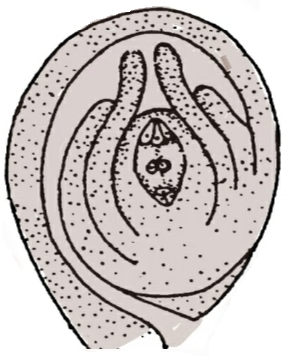
  1. Refer to the given figure and select the correct statement regarding it.
  1. This type of ovule is found in cactus.
  2. The micropyle comes to lie close to the funiculus due to unilateral growth of ovule.
  3. It is most common type of ovule found in the members of Chenopodiaceae.
  4. It is half inverted ovule.
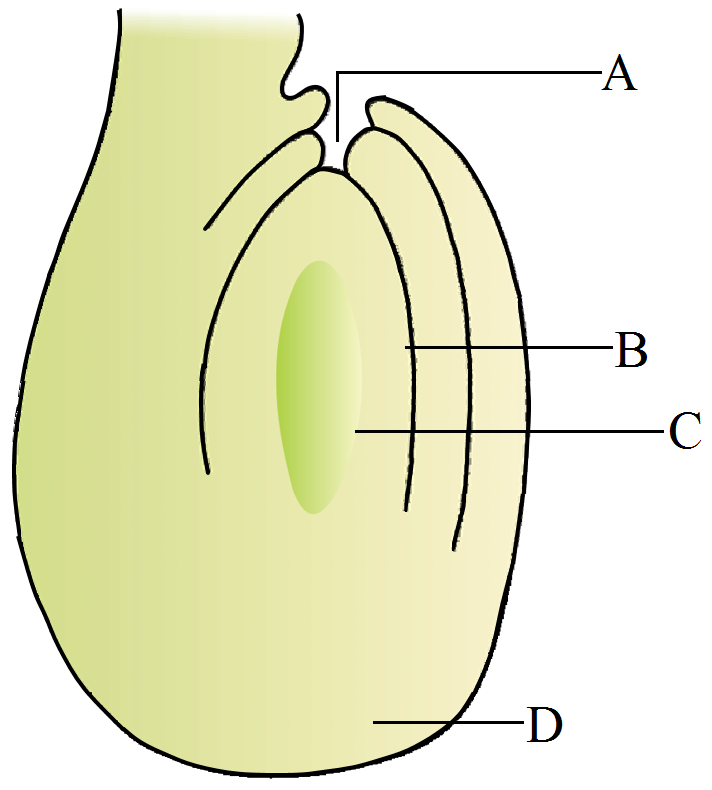
  1. Identify the parts labelled as $A, B, C$ and $D$ in the given figure and select the correct option.
S. No $A$ $B$ $C$ $D$
$(a)$ Chalaza Female gametophyte Embryo sac Micropyle
$(b)$ Chalaza NuceIIus Embryo sac Micropyle
$(c)$ Micropyle Egg Embryo sac Chalaza
$(d)$ Micropyle Nucellus Embryo sac Chalaza
  1. Mature ovules are classified on the basis of funiculus. If micropyle lie close to the funiculus, the ovule is termed as:
  1. Orthotropous.
  2. Anatropous.
  3. Hemitropous.
  4. Campylotropous.
  1. In Asphodel us, ovule is:
  1. Unitegmic.
  2. Tritegmic.
  3. Bitegmic.
  4. Ategmic.