MCQ
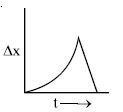
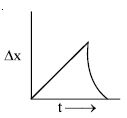
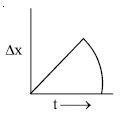
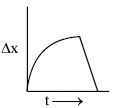
Two stones are thrown up vertically and simultaneously but with different speeds. Which graph correctly represents the time variation of their relative positions $\Delta x$.Assume that stones do not bounce after hitting ground.
  • A

  • B


  • D

Answer

Correct option: C.

c

Need a full question paper?

Generate a complete, print-ready paper with questions like this in minutes — across 16+ boards, with answer keys.
Start Generating Free

Similar questions

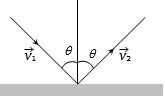
An object of $m\, kg$ with speed of $v\, m/s$ strikes a wall at an angle $\theta$ and rebounds at the same speed and same angle. The magnitude of the change in momentum of the object will be
The anode of a thermionic diode is connected to the negative terminal of a battery and the cathode to its positive terminal:
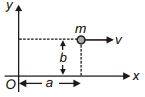
A particle of mass $m$ is moving with constant velocity $v$ parallel to the $x$-axis as shown in the figure. Its angular momentum about origin $O$ is ..........
One end of a long metallic wire of length $L$ is tied to the ceiling. The other end is tied to massless spring of spring constant $K$. A mass $ m$ hangs freely from the free end of the spring. The area of cross-section and Young's modulus of the wire are $A$ and $Y$ respectively. If the mass is slightly pulled down and released, it will oscillate with a time period $T$ equal to
Three rods each of length $L$ and mass $M$ are placed along $X$, $Y$ and $Z$ - axes in such a way that one end of each of the rod is at the origin. The moment of inertia of this system about $Z$ axis is
For cooking the food, which of the following type of utensil is most suitable
The density $\rho $ of water of bulk modulus $B $ at a depth y in the ocean is related to the density at surface ${\rho _0}$ by the relation
A air bubble of radius $1\,cm$ in water has an upward acceleration $9.8\, cm\, s ^{-2}$. The density of water is $1\, gm\, cm ^{-3}$ and water offers negligible drag force on the bubble. The mass of the bubble is$.......gm$

$\left( g =980 \,cm / s ^{2}\right)$

In Guericke's experiment to show the effect of atmospheric pressure, two copper hemispheres were tightly fitted to each other to form a hollow sphere and the air from the sphere was pumped out to create vacuum inside. If the radius of each hemisphere is $R$ and the atmospheric pressure is $p$, then the minimum force required (when the two hemispheres are pulled apart by the same force) to separate the hemispheres is
In a simple harmonic wave, minimum distance between particles in same phase always having same speed, is ..........