Question

Two straight horizontal parallel wires are carrying the same current in the same direction, d is the distance between the wires. You are provided with a small freely suspended magnetic needle. At which of the following positions will the orientation of the needle be independent of the magnitude of the current in the wires

(a) At a distance d/2  from any of the wires

(b) At a distance d/2  from any of the wires in the horizontal plane

(c) Anywhere on the circumference of a vertical circle of radius d and centre halfway between the wires

(d) At points halfway between the wires in the horizontal plane

Answer

(d) At points halfway between the wires in the horizontal plane

Need a full question paper?

Generate a complete, print-ready paper with questions like this in minutes — across 16+ boards, with answer keys.

Start Generating Free

Similar questions

An atom of mass number 15 and atomic number 7 captures an α - particle and then emits a proton. The mass number and atomic number of the resulting product will respectively be

(a) 14 and 2

(b) 15 and 3

(c) 16 and 4

(d) 18 and 8

The atomic number of Helium is 4 and Sulphur $S$ is 32 . The radius of nucleus of sulphur is larger than that of Helium by __________ .

A thin lens focal length  and its aperture has diameter d. It forms an image of intensity I. Now the central part of the aperture upto diameter   is blocked by an opaque paper. The focal length and image intensity will change to

(a)  and  

(b) f   and  

(c)  and  

(d) f   and  

The minimum wavelength of X-rays produced in a coolidge tube operated at potential difference of 40 kV is

(a) 0.31 Å

(b) 3.1 Å

(c) 31 Å   

(d) 311 Å

The material of wire of potentiometer is

(a) Copper

(b) Steel

(c) Manganin

(d) Aluminium

If the direction of the initial velocity of a charged particle is neither along nor perpendicular to that of the magnetic field, then the orbit will be:

The electric potential at a point (x, y) in the  x - y  plane is given by V = -kxy. The field intensity at a distance r from the origin varies as

(a)  

(b) r

(c)   

(d)  

A current i passes through a wire of length l, radius of cross-section r and resistivity r. The rate of heat generation is

(a)  

(b)

(c)

(d) ilρ/r

According to classical theory, path of electron in Rutherford model :

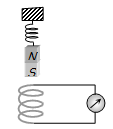
A magnet NS is suspended from a spring and while it oscillates, the magnet moves in and out of the coil C. The coil is connected to a galvanometer G. Then as the magnet oscillates,

(a) G shows deflection to the left and right with constant amplitude

(b) G shows deflection on one side

(c) G shows no deflection.

(d) G shows deflection to the left and right but the amplitude steadily decreases.