Question
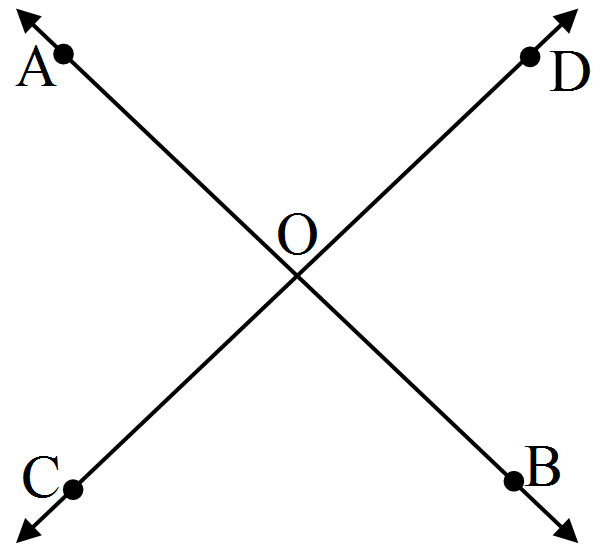
Two straight lines AB and CD intersect one another at the point O. If $\angle\text{AOC}+\angle\text{COB}+\angle\text{BOD}=274^\circ,$ then $\angle\text{AOD}=$

Need a full question paper?

Generate a complete, print-ready paper with questions like this in minutes — across 16+ boards, with answer keys.
Start Generating Free

Similar questions

Which one of the following statements is false?
  1. Only one line can pass through a single point.
  2. Two circles are equal when their radii are equal.
  3. A figure formed by line segments is called a rectilinear figure.
  4. A terminated line can be produced indefinitely on both the sides.
    The radii of two cylinders are in the ratio 2 : 3 and their heights are in the ratio 5 : 3. The ratio of their curved surface areas is
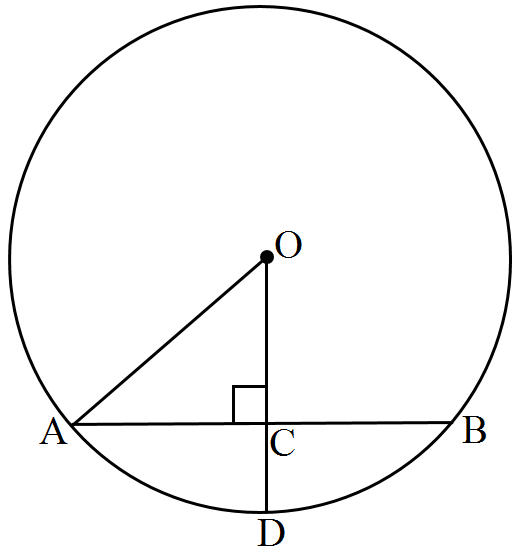
    In the given figure if $OA = 5\ cm, AB = 8\ cm$ and $OD$ is perpendicular to $AB,$ then $CD$ is equal to:
    The perimeter of a rhombus is $146\ cm.$ One of its diagonals is $55\ cm$. The length of the other diagonal and area of the rhombus are:
    $4a^2 + b^2 + 4ab + 8a + 4b + 4 =?$
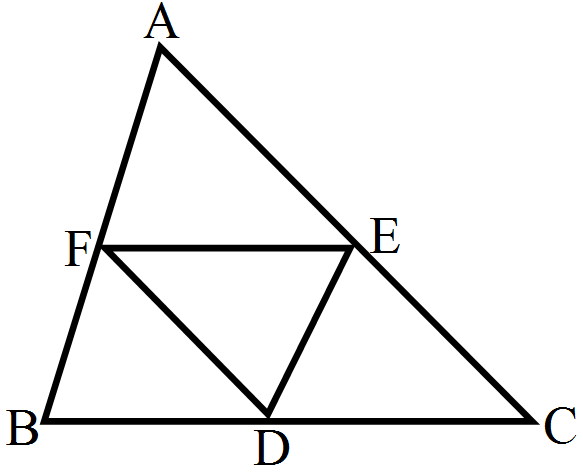
    Short Answer Questions. In the adjoining figure, BDEF and AFDE are parallelograms. Is AF = FB? Why or why not?  
    If a solid sphere of radius 10cm is moulded into 8 spherical solid balls of equal radius, then the surface area of each ball (in sq.cm) is:
    In the following, write the correct answer.It is given that $\triangle\text{ABC}=\triangle\text{FDE}$ and AB = 5 cm, $∠\text{B} = 40°$and $∠\text{A} = 80°$then which of the following is true?
    1. $\text{DF}=5\text{CM}, \angle\text{F}=60^{\circ}$
    2. $\text{DF}=5\text{CM}, \angle\text{E}=60^{\circ}$
    3. $\text{DE}=5\text{CM}, \angle\text{E}=60^{\circ}$
    4. $\text{DE}=5\text{CM}, \angle\text{D}=40^{\circ}$