MCQ
Two straight parallel wires, both carrying $10$ ampere in the same direction attract each other with a force of $1\times 10^{-3}N$. If both currents are doubled, the force of attraction will be
  • A
    $1\times 10^{-3}N$
  • B
    $2 \times 10^{-3}N$
  • $4 \times 10^{-3}N$
  • D
    $0.25 \times 10^{-3}N$ 

Answer

Correct option: C.
$4 \times 10^{-3}N$
$4 \times 10^{-3}N$

Need a full question paper?

Generate a complete, print-ready paper with questions like this in minutes — across 16+ boards, with answer keys.

Start Generating Free

Similar questions

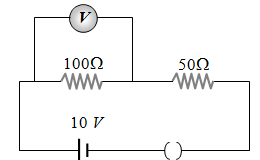
In the given circuit, the voltmeter records $5$ volts. The resistance of the voltmeter in ohms is
An oscillator is nothing but an amplifier with(a) Positive feed back(b) Large gain(c) No feedback(d) Negative feedback
   
   
Einstein's photoelectric equation states that $E_k=hv-\phi$. In this equation $E_k$ refers to
An object is at a distance of 0.5 m in front of a plane mirror. Distance between the object and image is(a) 0.5 m                                            (b) 1 m(c) 0.25 m(d) 1.5 m
       
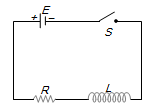
Switch $S$ of the circuit shown in figure. is closed at $t = 0.$ If $e$ denotes the induced

$emf$ in $L$ and $i,$ the current flowing through the circuit at time $t,$ which of the following graphs is correct 
If the capacitors in the previous question are joined in parallel, the capacitance and the breakdown voltage of the combination will be:
In circular coil, when no. of turns is doubled and resistance becomes $\frac{1}{4} ^{th}$ ur ınitial, then inductance becomes
An electron in the n = 1 orbit of hydrogen atom is bound by 13.6 eV. If a hydrogen atom is in the n = 3 state, how much energy is required to ionize it(a) 13.6 eV(b) 4.53 eV(c) 3.4 eV (d) 1.51 eV
       
If the wavelength of light in an experiment on photoelectric effect is doubled:
Assertion  :   The temperature coefficient of resistance is positive for metals and negative for p-type semiconductor.
Reason      : The effective charge carriers in metals are negatively charged whereas in p-type semiconductor they are positively charged.(a) If both assertion and reason are true and the reason is the correct explanation of the assertion.(b) If both assertion and reason are true but reason is not the correct explanation of the assertion.(c) If assertion is true but reason is false.(d) If the assertion and reason both are false.