MCQ
Two straight parallel wires, both carrying 10 ampere in the same direction attract each other with a force of $1\times 10^{-3}$N. If both currents are doubled, the force of attraction will be
  • A
    $ 1\times 10^{-3}$N
  • B
    $2 \times 10^{-3}$N
  • $ 4 \times 10^{-3}$N
  • D
    $ 0.25 \times 10^{-3}$N

Answer

Correct option: C.
$ 4 \times 10^{-3}$N
(c)$ 4\times 10^{-3}$N

Need a full question paper?

Generate a complete, print-ready paper with questions like this in minutes — across 16+ boards, with answer keys.

Start Generating Free

Similar questions

Carbon, Silicon and Germanium atoms have four valence electrons each. Their valence and conduction bands are separated by energy band gaps represented by $(E_g)_C$, $(E_g)_{Si}$ and $(E_g)_{Ge}$ respectively. Which one of the following relationship is true in their case?
A solenoid of 1.5 metre length and 4.0 cm diameter posses 10 turn per cm. A current of 5 ampere is flowing through it. The magnetic induction at axis inside the solenoid is
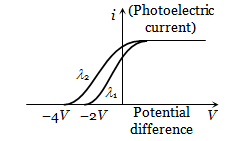
The maximum value of stopping potential in the following diagram is
In the following atoms and moleculates for the transition from n = 2 to n = 1, the spectral line of minimum wavelength will be produced by
A proton of energy 8 eV is moving in a circular path in a uniform magnetic field. The energy of an alpha particle moving in the same magnetic field and along the same path will be
Two identical photo-cathodes receive light of frequencies ${f_1}$ and ${f_2}$. If the velocities of the photo electrons (of mass $m$) coming out are respectively ${v_1}$ and ${v_2}$, then
Four different independent waves are represented by $(i)$ ${y_1} = {a_1}\sin \omega t$ $(ii)$ ${y_2} = {a_2}\sin 2\,\omega t$ $(iii)$ ${y_3} = {a_3}\cos \omega t$ $(iv)$ ${y_4} = {a_4}\sin \left( {\omega t + \frac{\pi }{3}} \right)$ With which two waves interference is possible
Which of the following is vector quantity
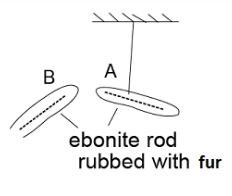
The property between two charged ebonite rods is:
Point $P$ lies on the axis of a dipole. If the dipole is rotated by $90^o$ anticlock wise, the electric field vector $E$ at $P$ will rotate by