Question
Two strings of the same material and length under the same tension may vibrate with different fundamental frequency. Why?

Answer

The frequency of vibration of string is
given by $\text{n}=\frac{1}{2\text{l}}\sqrt{\frac{\text{T}}{\text{m}}}$
m (mass per unit length) $=\frac{\text{mass}}{\text{length}}=\frac{\text{volume}\times\text{density}}{\text{l}}$
$=\frac{\pi\text{r}^2\text{l}\times\rho}{\text{l}}=\pi\text{r}^2\rho$
$=\pi\Big(\frac{\text{D}}{2}\Big)^2\rho=\frac{\pi\text{D}^2}{4}\rho$
$\text{n}=\frac{1}{2\text{l}}\sqrt{\frac{4\text{T}}{\pi\text{D}^2\rho}}=\frac{1}{\text{Dl}}\sqrt{\frac{\text{T}}{\pi\rho}}$
$\therefore \text{n}\propto\frac{1}{\text{D}}$ (when l, T, $\rho$ are same)
or nD = constant or $n_1D_1 = n_2D_2$​​​​​​​
Hence the two strings may vibrate with different frequencies when they have different diameters.

Need a full question paper?

Generate a complete, print-ready paper with questions like this in minutes — across 16+ boards, with answer keys.
Start Generating Free

Similar questions

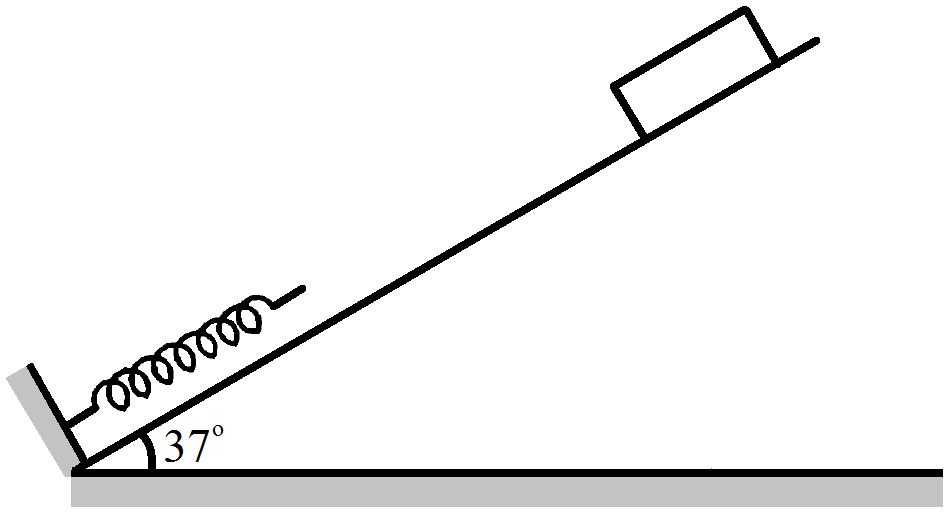
Figure shows a spring fixed at the bottom end of an incline of inclination $37^\circ $. A small block of mass $2\ kg$ starts slipping down the incline from a point $4.8m$ away from the spring. The block compresses the spring by $20\ cm$, stops momentarily and then rebounds through a distance of $1m$ up the incline. Find.
  1. The friction coefficient between the plane and the block.
  2. The spring constant of the spring. Take $g = 10m/s^2$​​​​​​​.
The force required to just move a body up an inclined plane is double the force required to prevent the body from sliding down. Find the coefficient of friction.
A dumb-bell consists of two identical small balls of mass $\frac{1}{2}\text{kg}$ each connected to the two ends of a 50cm long light rod. The dumb-bell is rotating about a fixed axis through the centre of the rod and perpendicular to it at an angular speed of 10rad/s. An impulsive force of average magnitude 5.0N acts on one of the masses in the direction of its velocity for 0.10s. Find the new angular velocity of the system.
A physical quantity X is related to four measurable quantities a, b, c and d as follows: $\text{X}=\text{a}^2\text{b}^3\text{c}^\frac{5}{2}\text{d}^{-2}.$ The percentage error in the measurement of a, b, c and d are 1%, 2%, 3% and 4%, respectively. What is the percentage error in quantity X? If the value of X calculated on the basis of the above relation is 2.763, to what value should you round off the result.
For a glass prism of refracting angle 60°, the minimum angle of deviation $D_m$ is found to be 36° with a maximum error of 1.05°. When a beam of parallel light is incident on the prism, find the range of experimental value of refractive index $'μ'.$ It is known that the refractive index $'μ'$ of the material of the prism is given by: $\mu=\frac{\sin\Big(\frac{\text{A}+\text{D}_\text{m}}{2}\Big)}{\sin\frac{\text{A}}{2}}$
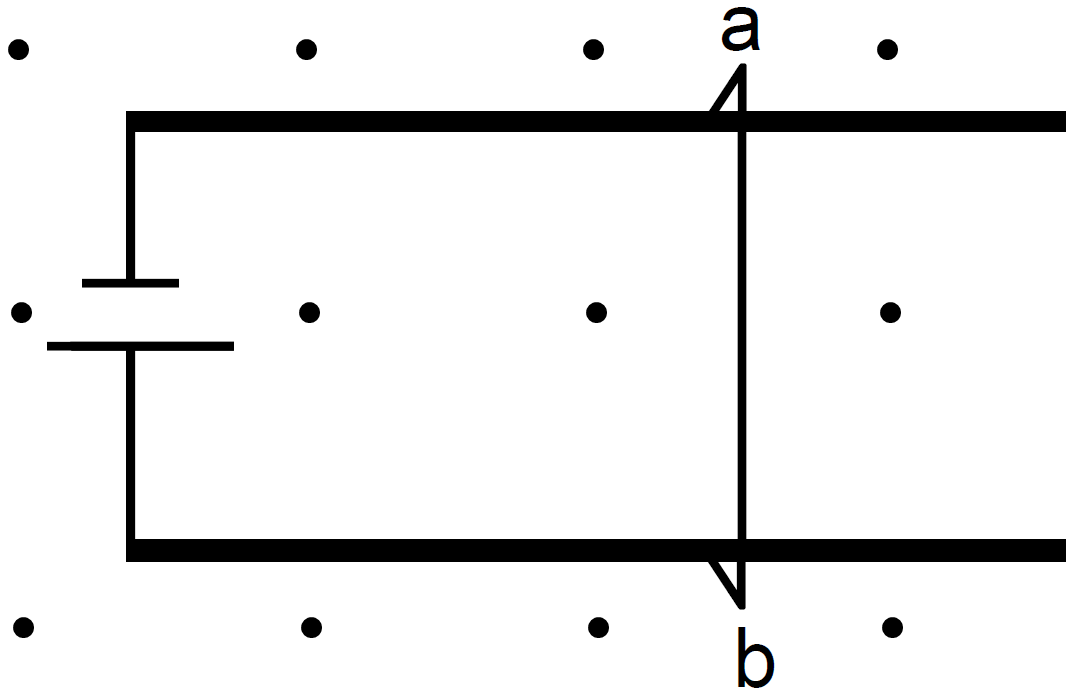
Figure shows a smooth pair of thick metallic rails connected across a battery of $\text{emf} \in$ having a negligible internal resistance. A wire $ab$ of length $l$ and resistance $r$ can slide smoothly on the rails. The entire system lies in a horizontal plane and is immersed in a uniform vertical magnetic field $B.$ At an instant $t,$ the wire is given a small velocity $u$ towards right.
  1. Find the current in it at this instant. What is the direction of the current?
  2. What is the force acting on the wire at this instant?
  3. Show that after some time the wire $ab$ will slide with a constant velocity. Find this velocity.
A particle is projected with a speed u at an angle $\theta$ with the horizontal. Consider a small part of its path near the highest position and take it approximately to be a circular arc. What is the radius of this circle? This radius is called the radius of curvature of the curve at the point.
A body is projected vertically upwards from A, the top of a tower it reaches the ground in it $t_1$, second. If it is projected vertically downwards from A with the same velocity it reaches the ground in $t_2$ second. If it falls freely, from A, prove that it would reach the ground in $\sqrt{\text{t}_1\text{t}_2}$ second.
State first law of thermodynamics. What are its limitations? Why $C_p > C_v$?
A body is moving with a uniform acceleration. Its velocity after 5 seconds is $25m/s$ and after $8$ seconds is $34m/s$. Calculate the distance it will cover in $10^{th}$ second.