Question
Two taps can fill a cistern in 10 hours and 8 hours respectively. A third tap can empty it in 15 hours. How long will it take to fill the empty cistern, if all of them are opened together?

Answer

First tap can fill a cistern in 10 hours
Second tap can fill the cistern in 8 hours
Third tap can empty the cistern in 15 hours
$\therefore$ First tap's 1 hour's work $=\frac{1}{10}$
Second tap's 1 hour's work $=\frac{1}{8}$
and third tap's 1 hour's work $=\frac{1}{15}$
If all of them are opened together, then
heir one hour's work $=\frac{1}{10}+\frac{1}{8}-\frac{1}{15}$
$=\frac{12+15-8}{120}=\frac{27-8}{120}=\frac{19}{120}$
$\therefore$ They can fill the cistren in $=\frac{120}{19}$ hours
$=6 \frac{6}{19}$ hours

Need a full question paper?

Generate a complete, print-ready paper with questions like this in minutes — across 16+ boards, with answer keys.
Start Generating Free

Similar questions

Ranjan Singh makes statues of brass. Brass is an alloy of copper and zinc. Ranjan uses two varieties of brass for different kinds of statues. Variety 1 contains copper and zinc mixed in the ratio $7: 4$ and variety 2 contains these metals in the ratio $5: 3$. Ranjan makes an elephant statue from variety 1 and a horse statue from variety 2. The elephant statue weighs 176 g and it is known that the brass used in the horse statue contains 135 g zinc.
Q.1. Find the quantity of copper present in the brass used to make the elephant statue.
(a) 98 g $\quad$$\quad$(b) 112 g$\quad$$\quad$ (c) 121 g $\quad$$\quad$(d) 132 g
Q.2. How much copper is contained in the brass used to make the horse statue?
(a) 165 g $\quad$$\quad$(b) 175 g$\quad$$\quad$ (c) 205 g$\quad$$\quad$ (d) 225 g
Q.3. How much zinc is contained in the brass used to make the two statues?
(a) 169 g $\quad$$\quad$(b) 179 g$\quad$$\quad$ (c) 189 g$\quad$$\quad$ (d) 199 g
Q.4. The ratio of the quantities of copper and zinc used to make the two statues is:
(a) $113: 98$ $\quad$$\quad$(b) $337: 148$ $\quad$$\quad$(c) $221: 199$ $\quad$$\quad$(d) $337: 199$
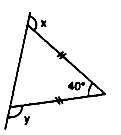
Apply the properties of isosceles and equilateral triangles to find the unknown angles in the given figure:
Evaluate: $-\frac{5}{7}-\left(-\frac{3}{8}\right)$
Birju is a fruitseller. Today he bought pears to sell. He purchased them at the rate of 8 for ₹ 75 from the wholesale market.
Q.1. How many pears should he sell for 90 if he wishes to gain 20% ?
(a) 6 $\quad$$\quad$(b) 7$\quad$$\quad$ (c) 8$\quad$$\quad$ (d) 9
Q.2. He found that another fruitseller Ghanshyam was selling pears at 9 for₹90. Find the gain per cent of Ghanshyam. (Assume that the wholesale rate is the same for all fruitsellers.)
(a) $6 \frac{2}{3} \%$$\quad$$\quad$(b) $7 \frac{1}{2} \%$$\quad$$\quad$(c) $8 \frac{1}{3} \%$$\quad$$\quad$(d) $9 \frac{3}{3} \%$
Q.3. He decides to sell pears at the rate of 8 for₹90. Find his gain per cent :
(a) $15 \%$$\quad$$\quad$(b) $17 \frac{1}{2} \%$$\quad$$\quad$(c) $20 \%$$\quad$$\quad$(d) $22 \frac{1}{2} \%$
Q.4. In a box of 120 pears, he found that 24 were rotten and he had to throw them away. He sold the remaining pears at 8 for₹90. Find his gain or less per cent on this box :
(a) 2%, gain $\quad$$\quad$(b) 4%, loss $\quad$$\quad$$\quad$(c) 6%, gain$\quad$$\quad$ (d) 8%, loss
Evaluate: $\left(\frac{11}{-9} \times \frac{21}{44}\right)+\left(\frac{-5}{9}\right) \times\left(\frac{63}{-100}\right)$
Evaluate: 18 -(20 - 15 ÷ 3)
18.5 m of cloth costs Rs. 666. Find the cost of 3.8 m cloth.
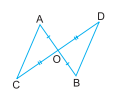
In the given figure, we have $A O=B O$ and $C O=D O$.
Prove that :
(i) $\triangle AOC \cong \triangle BOD$
(ii) $AC = BD$
Image
Find die cost of 17.5 m cloth at the rate of Rs. 112.50 per meter.
One of the base angles of an isosceles triangle is 52°. Find its angle of the vertex.