Question
Two thin long parallel wires separated by a distance $b$ are carrying a current $i$ $amp$ each. The magnitude of the force per unit length exerted by one wire on the other is

Answer

(b) Force per unit length $ = \frac{{{\mu _0}}}{{4\pi }}.\frac{{2{i_1}{i_2}}}{r} = \frac{{{\mu _0}}}{{2\pi }}.\frac{{{i^2}}}{b}$

Need a full question paper?

Generate a complete, print-ready paper with questions like this in minutes — across 16+ boards, with answer keys.
Start Generating Free

Similar questions

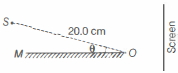
A monochromatic light source $S$ of wavelength $440 \,nm$ is placed slightly above a plane mirror $M$ as shown below. Image of $S$ in $M$ can be used as a virtual source to produce interference fringes on the screen. The distance of source $S$ from $O$ is $20.0 \,cm$ and the distance of screen from $O$ is $100.0 \,cm$ (figure is not to scale). If the angle $\theta=0.50 \times 10^{-3}$ radians, then the width of the interference fringes observed on the screen is ............... $mm$
Kepler's third law states that square of period of revolution $(T)$ of a planet around the sun, is proportional to third power of average distance $r$ between sun and planet i.e.

$\therefore \;{T^2} = k{r^3}$

here $K$ is constant.

If the masses of sun and planet are $M$ and $m$ respectively then as per Newton's law of gravitation force of attraction between them is $F = \frac{{GMm}}{{{r^2}}}$ , here $G$ gravitational constant . The relation between $G$ and $K$ is described as
The beam of light has three wavelengths $4144 \,\mathring A$, $4972 \;\mathring A$ and $6216\; \mathring A$ with a total intensity of $3.6 \times$ $10^{-5}\,Wm ^2$ equally distributed amongst the three wavelengths. The beam falls normally on the area $1\,cm ^2$ of a clean metallic surface of work function $2.3\,eV$. Assume that there is no loss of light by reflection and that each energetically capable photon ejects one electron. Calculate the number of photoelectrons liberated in $2\,s$.
The maximum amplitude for an amplitude modulated wave is found to be $12\, {V}$ while the minimum amplitude is found to be $3\, {V}$. The modulation index is $0.6\, {x}$ where ${x}$ is $....\, .$
Consider an electromagnetic wave propagating in vacuum . Choose the correct statement
A ray of light passes through an equilateral glass prism in such a manner that the angle of incidence is equal to the angle of emergence and each of these angles is equal to $3/4$ of the angle of the prism. The angle of deviation is......$^o$
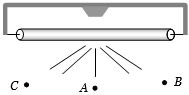
Figure shows a glowing mercury tube. The illuminances at point $A, B$ and $C$ are related as
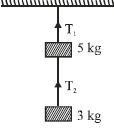
Two masses of $5\, kg$ and $3\, kg$ are suspended with the help of massless inextensible strings as shown in figure. The whole system is going upwards with an acceleration of $2\, ms^{-2}$. The tensions $T_1$ and $T_2$ are respectively (Take $g = 10\, ms^{-2}$)
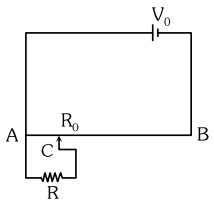
The sliding contact $C$ is at one fourth of the length of the potentiometer wire $( AB )$ from $A$ as shown in the circuit diagram. If the resistance of the wire $AB$ is $R _0$, then the potential drop $( V )$ across the resistor $R$ is
A bullet from a gun is fired on a rectangular wooden block with velocity $u$.When bullet travels $24\,cm$ through the block along its length horizontally, velocity of bullet becomes $\frac{u}{3}$. Then it further penetrates into the block in the same direction before coming to rest exactly at the other end of the block. The total length of the block is $........\,cm$