MCQ
Two travelling waves produces a standing wave represented by equation,

${y}=1.0\, {mm} \cos \left(1.57 \,{cm}^{-1}\right) {x} \sin \left(78.5\, {s}^{-1}\right) {t}$

The node closest to the origin in the region ${x}>0$ will be at ${x}=\ldots \ldots \ldots\, {cm}$

  • A
    $3$
  • $1$
  • C
    $5$
  • D
    $7$

Answer

Correct option: B.
$1$
b
For node

$\cos \left(1.57 {cm}^{-1}\right) {x}=0$

$\left(1.57 {cm}^{-1}\right) {x}=\frac{\pi}{2}$

${x}=\frac{\pi}{2(1.57)} {cm}=1\, {cm}$

Need a full question paper?

Generate a complete, print-ready paper with questions like this in minutes — across 16+ boards, with answer keys.

Start Generating Free

Similar questions

A particle moves in a circle of radius $25\, cm$ at two revolutions per second. The acceleration of the particle in $meter/second^2$ is
In the climax of a movie, the hero jumps from a helicopter and the villain chasing the hero also jumps at the same time from the same level. After sometime when they were at same horizontal level, the villain fires bullet horizontally towards the hero. Both were falling with constant acceleration $2\ m/s^2$ , because of parachute. Assuming the hero to be within the range of bullet, and air resistace force on bullet is negligible. Which of the following is correct
The dimensions of $C{V^2}$ matches with the dimensions of
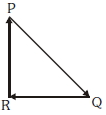
A particle moving with velocity $\overrightarrow{\mathrm{V}}$ is acted by three forces shown by the vector triangle $PQR$. The velocity of the particle will 
The angular speed of the wheel of a vehicle is increased from $360 \;rpm$ to $1200 \;rpm$ in $14 \;second$. Its angular acceleration is,
Two soap bubbles $A$ and $B$ are formed at the two open ends of a tube. The bubble $A$ is smaller than bubble $B.$ If the value on the tube connecting the two bubbles is opened and air can flow freely between the bubbles, then:
The instantaneous velocity of a body can be measured
A particle located at $x= 0$ at time $ t= 0 $, starts moving along with the positive $x-$direction with a velocity $v$ that varies as $v$ $=$ $\alpha \sqrt x $. The displacement of the particle varies with time as
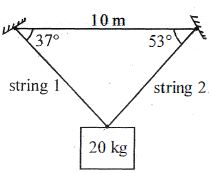
A mass of $20\  kg$ is hanging with support of two strings of same linear mass density. Now pulses are generated in both strings at same time near the joint at mass. Ratio of time, taken by a pulse travel through string $1$ to that taken by pulse on string $2$ is
The displacement equations of two interfering waves are given by

$y_1  =10 \sin \left(\omega t+\frac{\pi}{3}\right) cm$

$y_2 =5[\sin (\omega t)+\sqrt{3} \cos \omega t] \;cm$ respectively.

The amplitude of the resultant wave is $.............cm$.