MCQ
Two tuning forks $A$ and $B$ give $4$ beats per second. The frequency of $A$ is $256 Hz$. On loading $B$ slightly, we get $5$ beats in $2$ seconds. The frequency of $B$ after loading is .... $Hz$
  • A
    $253.5$
  • B
    $258.5$
  • $260 $
  • D
    $252 $

Answer

Correct option: C.
$260 $
c
(c) $n_A$ = Known frequency$ = 256 Hz, n_B = ?$
$x = 4$ beats per sec which is decreasing ($4\, bps$ to $\frac{5}{2}bps$) after loading (i.e. $x\downarrow$)
Unknown tuning fork $B,$ is loaded so $ n_B\downarrow$
Hence $n_A -n_B\downarrow = x\downarrow$ ... $(i)$ $\rightarrow$ Wrong
$n_B\downarrow-n_A = x\downarrow$ ... $(ii)$ $\rightarrow$ Correct
$\Rightarrow$ $n_B = n_A + x = 256 + 4 = 260 Hz.$

Need a full question paper?

Generate a complete, print-ready paper with questions like this in minutes — across 16+ boards, with answer keys.
Start Generating Free

Similar questions

If given wave has propagation constant $\frac{5 \pi}{7}\, rad/m$ then phase difference between two particle having distance difference $\frac{49}{22} \,m$ is ..... $rad.$
Which factor does not affect convection?
The second overtone of an open organ pipe $A$ and a closed pipe $B$ have the same frequency at a given temperature. It follows that the ratio of the
An object of mass $m$ is sliding down a hill of arbitrary shape and after traveling a certain horizontal path stops because of friction. The friction coefficient is different for different segments of the entire path but it is independent of the velocity and direction of motion. The work done that a force must perform to return the object  its initial position along the same path would be :-
A particle of mass $M$ moves with constant speed along a circular path of radius $ r$ under the action of a force $F$. Its speed is
A man throws a ball vertically upward and it rises through $20 \;m$ and returns to his hands. What was the initial velocity $(u)$ of the ball and for how much time $(T)$ it remained in the air $[g = 10\,m/{s^2}]$
In a stationary wave,
  1. All the particles of the medium vibrate in phase.
  2. All the antinodes vibrate in phase.
  3. The alternate antinodes vibrate in phase.
  4. All the particles between consecutive nodes vibrate in phase.
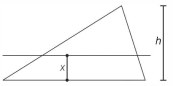
Which one of the following four graphs best depict the variation with $x$ of the moment of inertia $I$ of a uniform triangular lamina about an axis parallel to its base at a distance $x$ from it?
A mercury drop of $1\, cm$ radius is broken into ${10^6}$ small drops. The energy used will be (surface tension of mercury is $35 \times {10^{ - 3}}N/cm)$
A box contains n molecules of a gas. How will the pressure of the gas be effected, if the number of molecules is made $2n$