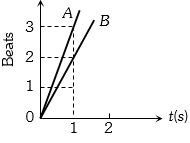
Two tuning forks $P$ and $Q$ are vibrated together. The number of beats produced are represented by the straight line $OA$ in the following graph. After loading $Q$ with wax again these are vibrated together and the beats produced are represented by the line $OB.$ If the frequency of $P$ is $341Hz,$ the frequency of $Q$ will be ... $ Hz$
Medium


Download our appand get started for free
Experience the future of education. Simply download our apps or reach out to us for more information. Let's shape the future of learning together!No signup needed.*
Similar Questions
- 1Equation of travelling wave on a stretched string of linear density $5\,g/m$ is $y = 0.03\,sin\,(450\,t -9x)$ where distance and time are measured in $SI$ united. The tension in the string is ... $N$View Solution
- 2A train moves towards a stationary observer with speed $34 m/s$. The train sounds a whistle and its frequency registered by the observer is ${f_1}$. If the train’s speed is reduced to $17\, m/s$, the frequency registered is ${f_2}$. If the speed of sound is 340 m/s then the ratio ${f_1}/{f_2}$ isView Solution
- 3A car $'A'$ chasing another car $'B'$ with a speed of $20\, m/s$ sounding a horn of $180\, Hz$. While both cars are moving towards a stationary siren of frequency $170\, Hz$. What is the speed of car $B$ so that it can't hear any beat ....$m/s$ (speed of sound $= 340\, m/s$)View Solution
- 4A source of sound of frequency $600 Hz$ is placed inside water. The speed of sound in water is $1500 m/s$ and in air is $300 m/s.$ The frequency of sound recorded by an observer who is standing in air is .... $Hz$View Solution
- 5A wave is represented by the equation : $y = a\sin (0.01x - 2t)$ where $a$ and $x$ are in $cm$. velocity of propagation of wave is .... $cm/s$View Solution
- 6For the stationary wave $y = 4\sin \,\left( {\frac{{\pi x}}{{15}}} \right)\cos (96\,\pi t)$, the distance between a node and the next antinode isView Solution
- 7A wave equation is given as $y = cos\,\,(500t - 70x),$ where $y$ is in $mm$, $x$ in $m$ and $t$ is in $sec$.View Solution
- 8A man is watching two trains, one leaving and the other coming in with equal speeds of $4\, m/sec$. If they sound their whistles, each of frequency $240 Hz$, the number of beats heard by the man (velocity of sound in air $= 320 m/sec$) will be equal toView Solution
- 9The speed of a transverse wave passing through a string of length $50 \;cm$ and mass $10\,g$ is $60\,ms ^{-1}$. The area of cross-section of the wire is $2.0\,mm ^{2}$ and its Young's modulus is $1.2 \times 10^{11}\,Nm ^{-2}$. The extension of the wire over its natural length due to its tension will be $x \times 10^{-5}\; m$. The value of $x$ is $...$View Solution
- 10A standing wave is formed by the superposition of two waves travelling in opposite directions. The transverse displacement is given by $y\left( {x,t} \right) = 0.5\sin\, \left( {\frac{{5\pi }}{4}x} \right)\,\cos\, \left( {200\,\pi t} \right)$. What is the speed of the travelling wave moving in the positive $x$ direction .... $m/s$ ? ($x$ and $t$ are in meter and second, respectively.)View Solution