MCQ
Two tuning forks when sounded together produced $4$ beats/sec. The frequency of one fork is $256.$ The number of beats heard increases when the fork of frequency $256$ is loaded with wax. The frequency of the other fork is
  • A
    $504$
  • B
    $520$
  • $260$
  • D
    $252$

Answer

Correct option: C.
$260$
c
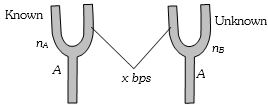
(c) Suppose two tuning forks are named $A$ and $B$ with frequencies ${n_A} = 256\,Hz$ (known), $n_B = ?$ (unknown), and beat frequency $x = 4 \,bps.$

Frequency of unknown tuning fork may be ${n_B} = 256 + 4 = 260\,Hz$ 

or $ = 256 - 4 = 252\,Hz$

It is given that on sounding waxed fork $A$ (fork of frequency $256 Hz$) and fork $B$, number of beats (beat frequency) increases. 

It means that with decrease in frequency of $A,$ the difference in new frequency of $A$ and the frequency of $B$ has increased.

This is possible only when the frequency of $A$ while decreasing is moving away from the frequency of $B.$

This is possible only if $n_B = 260 Hz.$

Alternate method : It is given ${n_A} = 256\,Hz,\,{n_B} = ?$ and $x = 4 \,bps$ 

Also after loading $A$ (i.e. $n_A \downarrow$), beat frequency (i.e. $x$) increases ($\uparrow$).

Apply these informations in two possibilities to known the frequency of unknown tuning fork. 

$n_A \downarrow -n_B = x\uparrow$ ... $(i)$

$n_B -n_A \downarrow = x\uparrow$ ... $(ii)$

It is obvious that equation $(i)$ is wrong $(ii)$ is correct so 

$n_B = n_A + x = 256 + 4 = 260 \,Hz.$
Need a full question paper?

Generate a complete, print-ready paper with questions like this in minutes — across 16+ boards, with answer keys.

Start Generating Free

Similar questions

Let us cell a motion, $A$ when velocity is positive and increasing $A^{-1}$ when velocity is negative and increasing. $R$ when velocity is positive and decreasing and $R^{-1}$ when velocity is negative and decreasing. Now, match the following two columns for the given $s=t$ graph.
Colum $I$ Colum $II$
$(A)$ $M$ $(p)$ $A^{-1}$
$(B)$ $N$ $(q)$ $R^{-1}$
$(C)$ $P$ $(r)$ $A$
$(D)$ $Q$ $(s)$ $R$

A ball of mass $0.2\ kg$ is thrown vertically upwards by applying a force by hand. If the hand moves $0.2\ m$ while applying the force and the ball goes upto $2\ m$ height further, find the  magnitude of the force .......... $N$ .(consider $g = 10\; m/s^2$)
In Ohm's experiment, the value of an unknown resistance were found to be $4.12\; \Omega, 4.08 \;\Omega, 4.22 \;\Omega$ and $4.14 \;\Omega$. Calculate absolute error and relative error in these measurement.
The work done in increasing the size of a soap film from 10cm × 6cm to 10cm × 11cm is 3 × 10⁻⁴J. The surface tension of the film is:
The position of a body moving along $x$-axis at time $t$ is given by $x=\left(t^2-4 t+6\right) m$. The distance travelled by body in time interval $t=0$ to $t=3 \,s$ is ...... $m$
Heat energy of $184\,kJ$ is given to ice of mass $600\,g$ at $-12^{\circ}\,C$, Specific heat of ice is $2222.3\,J\,kg ^{-1^{\circ}}\,C ^{-1}$ and latent heat of ice in $336\,kJ / kg ^{-1}$

$(A)$ Final temperature of system will be $0^{\circ} C$.

$(B)$ Final temperature of the system will be greater than $0^{\circ} C$.

$(C)$ The final system will have a mixture of ice and water in the ratio of $5: 1$.

$(D)$ The final system will have a mixture of ice and water in the ratio of $1: 5$.

$(E)$ The final system will have water only.

Choose the correct answer from the options given below:

The hour hand of a clock is $6\,cm$ long. The magnitude of the displacement of the tip of hour between $1:00\,PM$ to $5:00\,PM$ is
Select the correct statement about the reflection and refraction of a wave at the interface between the medium $1$ and $2$ the
$E,\,m,\,l$ and $G$ denote energy, mass, angular momentum and gravitational constant respectively, then the dimension of $\frac{{E{l^2}}}{{{m^5}{G^2}}}$ are
If the sun and the planets carried huge amounts of opposite charges,
  1. All three of Kepler’s laws would still be valid.
  2. Only the third law will be valid.
  3. The second law will not change.
  4. The first law will still be valid.