MCQ
Two uniform circular discs are rotating independently in the same direction around their common axis passing through their centres. The moment of inertia and angular velocity of the first disc are $0.1 \;kg - m ^{2}$ and $10\; rad \,s^{-1}$ respectively while those for the second one are $0.2 \;kg - m ^{2}$ and $5\; rad \,s ^{-1}$ respectively. At some instant they get stuck together and start rotating as a single system about their common axis with some angular speed. The Kinetic energy of the combined system is ...........$J$
  • A
    $3.33$
  • B
    $0.67$
  • C
    $1.67$
  • $6.67$

Answer

Correct option: D.
$6.67$
d
Both discs are rotating in same sense

Angular momentum conserved for the system

i.e. $\quad L _{1}+ L _{2}= L _{\text {final }}$

$I _{1} \omega_{1}+ I _{2} \omega_{2}=\left( I _{1}+ I _{2}\right) \omega_{ f }$

$0.1 \times 10+0.2 \times 5=(0.1+0.2) \times \omega_{f}$

$\omega_{ f }=\frac{20}{3}$

Kinetic energy of combined disc system

$\Rightarrow \frac{1}{2}\left( I _{1}+ I _{2}\right) \omega_{ f }^{2}$

$=\frac{1}{2}(0.1+0.2) \cdot\left(\frac{20}{3}\right)^{2}$

$=\frac{0.3}{2} \times \frac{400}{9}=\frac{120}{18}=\frac{20}{3} J$

Need a full question paper?

Generate a complete, print-ready paper with questions like this in minutes — across 16+ boards, with answer keys.

Start Generating Free

Similar questions

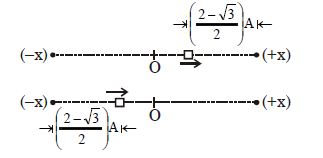
Two bodies performing $SHM$ have same amplitude and frequency. Their phases at a certain instant are as shown in the figure. The phase difference between them is
A car runs at a constant speed on a circular track of radius $100\,m$ , taking $62.8\,sec$ for every circular lap. The average velocity and average speed for each circular lap respectively is 
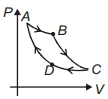
Carnot cycle is plotted in $P-V$ graph. Which portion represents an isothermal expansion?
How long will a train, running at a speed of 45kmph cross a standing man, given the length of the train is 450m?
A particle is moving along the $x-$axis with its coordinate with the time '$t$' given be $\mathrm{x}(\mathrm{t})=10+8 \mathrm{t}-3 \mathrm{t}^{2} .$ Another particle is moving the $y-$axis with its coordinate as a function of time given by $\mathrm{y}(\mathrm{t})=5-8 \mathrm{t}^{3} .$ At $\mathrm{t}=1\; \mathrm{s},$ the speed of the second particle as measured in the frame of the first particle is given as $\sqrt{\mathrm{v}} .$ Then $\mathrm{v}$ (in $\mathrm{m} / \mathrm{s})$ is
A point moves in a straight line so that its displacement $x\,m$ at time $t\,sec$ is given by $x^2 = 1 + t^2$. Its acceleration in $m/sec^2$ at a time $t\,sec$ is
From a 200m high tower, one ball is thrown upwards with speed of 10m/ s and another is thrown vertically downwards at the same speed simultaneously. The time difference of their reaching the ground will be nearest to:
How much energy will be necessary for making a body of 500 kg escape from the earth $[g = 9.8\,m/{s^2}$, radius of earth $ = 6.4 \times {10^6}\,m]$
Given below are two statements :

$Statement$ $(I)$ : Planck's constant and angular momentum have same dimensions.

$Statement$ $(II)$ : Linear momentum and moment of force have same dimensions.

In the light of the above statements, choose the correct answer from the options given below :

A cricket ball of mass $0.15\, kg$ is thrown vertically up by a bowling machine so that it rises to a maximum height of $20 \;m$ after leaving the machine. If the part pushing the ball applies a constant force $F$ on the ball and moves horizontally a distance of $0.2\, m$ while launching the ball, the value of $F($ in $N)$ is 

$\left(g=10\, m s^{-2}\right)$