MCQ
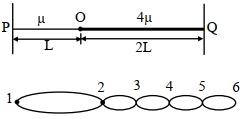
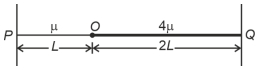
Two uniform strings of mass per unit length $\mu$ and $4 \mu$, and length $L$ and $2 L$, respectively, are joined at point $O$, and tied at two fixed ends $P$ and $Q$, as shown in the figure. The strings are under a uniform tension $T$. If we define the frequency $v_0=\frac{1}{2 L} \sqrt{\frac{T}{\mu}}$, which of the following statement($s$) is(are) correct?

$(A)$ With a node at $O$, the minimum frequency of vibration of the composite string is $v_0$

$(B)$ With an antinode at $O$, the minimum frequency of vibration of the composite string is $2 v_0$

$(C)$ When the composite string vibrates at the minimum frequency with a node at $O$, it has $6$ nodes, including the end nodes

$(D)$ No vibrational mode with an antinode at $O$ is possible for the composite string
  • $A,C,D$
  • B
    $A,C$
  • C
    $A,B,C$
  • D
    $A,B,D$

Answer

Correct option: A.
$A,C,D$
a
(image)

$C _1=\sqrt{\frac{ T }{\mu}}, C _2=\sqrt{\frac{ T }{4 \mu}}=\frac{ C _1}{2}$

For node at $O$ :

$L =\frac{ n \lambda_1}{2}, 2 L =\frac{ m \lambda_2}{2} \text { (n, } m \text { are integers) }$

$\lambda_1=\frac{2 L }{ n }, \lambda_2=\frac{4 L }{ m }$

$\frac{ C _1}{\lambda_1}=\frac{ C _2}{\lambda_2}$

$\Rightarrow \frac{ C _1}{\frac{2 L }{ n }}=\frac{\frac{ C _1}{2}}{\frac{4 L }{ m }}$

$\Rightarrow 4 n = m$

For minimum frequency, $n =1, m =4$

$\therefore v_{\min }=\frac{ C _1 \times 1}{2 L }=\frac{1}{2 L } \sqrt{\frac{ T }{\mu}}=v_0$

The string will look like

(image)

Total no. of nodes $=6$ including the end nodes

For antinode at $O$ :

$L =(2 n +1) \frac{\lambda_1}{4} ; 2 L =(2 n +1) \frac{\lambda_2}{4} \quad \text { (n, } m \text { are integers) }$

$\lambda_1=\frac{4 L }{(2 n +1)} ; \lambda_2=\frac{8 L }{(2 m +1)}$

$\frac{ C _1}{\lambda_1}=\frac{ C _2}{\lambda_2}$

$\frac{ C _1}{ C _2}=\frac{\lambda_1}{\lambda_2}$

$2=\frac{\frac{4 L }{(2 n +1)}}{\frac{8 L }{(2 m +1)}}$

$4=\frac{(2 m +1)}{(2 n +1)} \Rightarrow \text { even }=\frac{\text { odd }}{\text { odd }} \Rightarrow \text { This node is not possible }$

Need a full question paper?

Generate a complete, print-ready paper with questions like this in minutes — across 16+ boards, with answer keys.

Start Generating Free

Similar questions

The velocity of the centre of mass of a rigid rod with respect to an observer $O$ is $\vec v = \left( {2\hat i + 3\hat j} \right) ms^{-1}$ . The rod has an angular velocity about its centre of mass given by $\vec \omega$  =$\left( {3\hat j + 4\hat k} \right) s^{-1}$ . Let A be a point on the rod with position vector $2\left( {\hat i + \hat k} \right) m$ with respect to the centre of mass. The velocity of the point $A$ with respect to $O$ is
The equation of state corresponding to $8 \,g$ of ${O_2}$ is
Which of the following are not a unit of time?
Two projectiles are projected at $30^{\circ}$ and $60^{\circ}$ with the horizontal with the same speed. The ratio of the maximum height attained by the two projectiles respectively is:
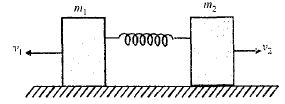
A spring is compressed between two blocks of masses $m_1$ and $m_2$  placed on a horizontal frictionless surface as shown in the figure. When the blocks arc released, they have initial velocity of $v_1$ and $v_2$ as shown. The blocks travel distances $x_1$ and $x_2$ respectively before coming to rest. The ratio $\left( {\frac{{{x_1}}}{{{x_2}}}} \right)$ is
When a car is approaching the observer, the frequency of horn is $100 Hz$. After passing the observer, it is $50\,Hz$. If the observer moves with the car, the frequency will be $\frac{ x }{3} Hz$ where $x =.....$
A tank is filled by liquid of density $\rho$ upto height $H$. The average pressure on the walls of container is .....
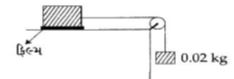
A metal block of base area $0.2\; m ^{2}$ is connected to a $0.02\; kg$ mass via a string that passes over an ideal pulley as shown in figure. A liquid film of thickness $0.6\; mm$ is placed between the block and the table. When released the block moves to the right with a constant speed of $0.17\; m / s$. The co-efficient of viscosity of the liquid is
A uniform force of $(3\hat i + \hat j)$ newton acts on a particle of mass $2\, kg.$ Hence the particle is displaced from position $(2\hat i +\hat k)$ metre to position $(4\hat i+3\hat j-\hat k)$ metre. The work done by the force on the particle is ............. $\mathrm{J}$
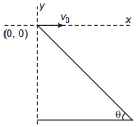
A man standing on a hill top projects a stone horizontally with speed $v_0$ as shown in figure. Taking the coordinates system as given in the figure. The coordinates of the point, where the stone will hit the hill surface are