MCQ
Two vectors $\overrightarrow A $ and $\overrightarrow B $ are at right angles to each other, when
  • A
    $\overrightarrow A + \overrightarrow B = 0$
  • B
    $\overrightarrow A - \overrightarrow B = 0$
  • C
    $\overrightarrow A \times \overrightarrow B = 0$
  • $\overrightarrow A \,.\,\overrightarrow B = 0$
Answer

Correct option: D.
$\overrightarrow A \,.\,\overrightarrow B = 0$
d
(d) $\vec A.\vec B = \,|\vec A|.|\vec B|.\cos \theta = \vec A.\vec B.\cos 90^\circ = 0$

Need a full question paper?

Generate a complete, print-ready paper with questions like this in minutes — across 16+ boards, with answer keys.

Start Generating Free

Similar questions

During an adiabatic compression, $830\, J$ of work is done on $2\, moles$ of a diatomic ideal gas to reduce its volume by $50\%$. The change in its temperahture is nearly..... $K$ $(R\, = 8.3\, J\,K^{-1}\, mol^{-1} )$
Consider the following statement: When jumping from some height, you should bend your knees as you come to rest, instead of keeping your legs stiff. Which of the following relations can be useful in explaining the statement
If opened door of a refrigerator in working condition kept in an insulated room:
The value of coefficient of volume expansion of glycerin is $5 \times 10^{-4}k^{-1} .$ The fractional change in the density of glycerin for a rise of $40^o C$ in its temperature, is
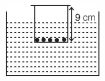
A wide bottom cylindrical massless plastic container of height $9 \,cm$ has $40$ identical coins inside it and is floating on water with $3 \,cm$ inside the water. If we start putting more of such coins on its lid, it is observed that after $N$ coins are put, its equilibrium changes from stable to unstable. Equilibrium in floating is stable if the geometric centre of the submerged portion is above the centre of the mass of the object). The value of $N$ is closed to
A cricket ball of mass $0.15\, kg$ is thrown vertically up by a bowling machine so that it rises to a maximum height of $20 \;m$ after leaving the machine. If the part pushing the ball applies a constant force $F$ on the ball and moves horizontally a distance of $0.2\, m$ while launching the ball, the value of $F($ in $N)$ is 

$\left(g=10\, m s^{-2}\right)$

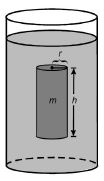
A right circular cylinder has a mass $m$, radius $r$, and a height $h$. The cylinder is completely submerged in a fluid of density $\rho$, as shown in the diagram. What is the magnitude of the net force on the cylinder?
A particle executes $SHM$ of amplitude $25\, cm$ and time period $3\, s$. What is the minimum time required for the particle to move between two points $12.5\, cm$ on either side of the mean position  ..... $\sec$ 
A free neutron decays to a proton but a free proton does not decay to a neutron. This is because:
  1. Neutron is a composite particle made of a proton and an electron whereas proton is a fundamental particle.
  2. Neutron is an uncharged particle whereas proton is a charged particle.
  3. Neutron has large rest mass than the proton.
  4. Weak forces can operate in a neutron but not in a proton.
If water is flowing in a pipe with speed $2 \,m / s$ then its kinetic energy per unit volume is ........... $J ^2 m ^3$