Question
Two vectors $\vec A\,{\rm{ and }}\vec B$ are such that $\vec A + \vec B = \vec A - \vec B$. Then

Answer

$\vec{A}+\vec{B}=\vec{A}-\vec{B}$

$(\vec{A}-\vec{A})+\vec{B}+\vec{B}=0$

$0+2\vec{B}=0$

$\vec{B}=0$

Need a full question paper?

Generate a complete, print-ready paper with questions like this in minutes — across 16+ boards, with answer keys.

Start Generating Free

Similar questions

The mass of a ${}_3^7Li$ nucleus is $0.042\,\, u$ less than the sum of the masses of all its nucleons. The binding energy per nucleon of $^7_3 Li$ nucleus is nearly...........$MeV$
The temperature of the body is increased from $-73^o C\, to \,327^o C$, the ratio of energy emitted per second is :
A satellite $A$ of mass $m$ is at a distance of $r$ from the centre of the earth. Another satellite $B$ of mass $2m$ is at a distance of $2r$ from the earth's centre. Their time periods are in the ratio of
Assertion $(A):$ If the frequency of the applied $AC$ is doubled, then the power factor of a series $R-L$ circuit decreases.

Reason $(R):$ Power factor of series $R-L$ circuit is given by $\cos \theta=\frac{2 R }{\sqrt{ R ^2+\omega^2 L ^2}}$
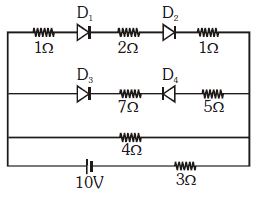
All the diodes are ideal. The current flowing in $2\,\Omega $ resistor connected between the diodes $D_1$ and $D_2$ is.......$A$
For $a$ gas $C_{p}-C_{V}=R$ in a state $P$ and $C_{p}-C_{V}=1.10 R$ in a state $Q, T_{p}$ and $T_{Q}$ are the temperatures in two different states $P$ and $Q$ respectively. Then
If velocity of a body is twice of previous velocity, then kinetic energy will become
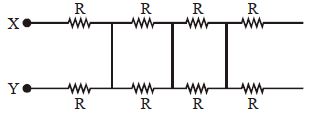
Net resistance between $X$ and $Y$ is
A photo cell is receiving light from a source placed at a distance of $1 m$. If the same source is to be placed at a distance of $2 m$, then the ejected electron
A constant force acting on a body of mass of $5\,kg$ changes its speed from $5\,ms^{-1}$ to $10\,ms^{-1}$ in $10\,s$ without changing the direction of motion. The force acting on the body is  ......... $N$