Question
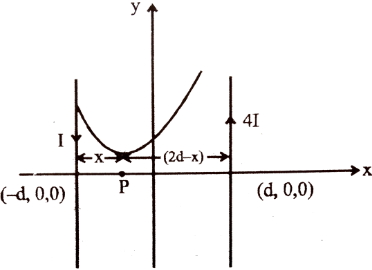
Two very long straight parallel wires, parallel to $y-$ axis,carrycurrents $4I$ and $I,$ along $+y$ directionand$-y$ direction, respectively. The wires are passes through the $x-$axis at the points $(d, 0, 0)$ and $(- d, 0, 0)$ respectively.The graph of magnetic field $z-$component as one moves along the $x-$axis from $x=- d$ to $x= +d,$ is best given by
Answer

$B=\left[\frac{\mu_{0}}{4 \pi} \frac{2 I}{x}+\frac{\mu_{0}}{4 \pi} \frac{2(4 I)}{4 \pi(2 d-x)}\right] \odot$

$=\frac{\mu_{0}}{4 \pi} 2 I\left[\frac{1}{x}+\frac{4}{(2 d-x)}\right]$

For $B$ to be minimum $\frac{d B}{d x}=0 \Rightarrow x=\frac{2 d}{3}$

Need a full question paper?

Generate a complete, print-ready paper with questions like this in minutes — across 16+ boards, with answer keys.

Start Generating Free

Similar questions

If at any point on the path of a projectile its velocity is $u$ at inclination $\alpha$ then it will  move at right angles to former direction after time
A boy walks to his school at a distance of $6\, km$ with constant speed of $2.5\, km/hour $ and walks back with a constant speed of $4 \,km/hr.$ His average speed for round trip expressed in $km/hour$, is
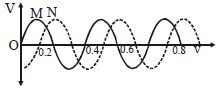
Two sinusoidal voltages of the same frequency are shown in the diagram. What is the frequency, and the phase relationship between the voltages Frequency in $Hz$    $\to $  Phase lead of $N$ over $M$ in radian
Given below are two statements

Statement $I:$ The equivalent resistance of resistors in a series combination is smaller than least resistance used in the combination.

Statement $II$ : The resistivity of the material is independent of temperature.

In the light of the above statements, choose the correct answer from the options given below

According to Maxwell’s hypothesis, a changing electric field gives rise to
A reversible heat engine converts one-fourth of the heat input into work. When the temperature of the sink is reduced by $52\, K$, its efficiency is doubled. The temperature in Kelvin of the source will be ...... .
For a gas the difference between the two specific heats is $4150\, J/kg\, K.$ What is the specific heats at constant volume of gas if the ratio of specific heat is $1.4$
The point on the pressure temperature phase diagram where all the phases co-exist is called
On a solid sphere lying on a horizontal surface a force $F$ is applied at a height of $R/2$ from the centre of mass. The initial acceleration of a point at the top of the sphere is (there is no slipping at any point)
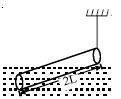
A slender homogeneous rod of length $2L$ floats partly immersed in water, being supported by a string fastened to one of its ends, as shown. The specific gravity of the rod is $0.75$. The length of rod that extends out of water is :