Two waves are approaching each other with a velocity of $20 m/s$ and frequency $n$. The distance between two consecutive nodes is
Easy
Download our app for free and get started
(b) Distance between the consecutive node $ = \frac{\lambda }{2},$
but $\lambda = \frac{v}{n} = \frac{{20}}{n}$ so $\frac{\lambda }{2} = \frac{{10}}{n}$
but $\lambda = \frac{v}{n} = \frac{{20}}{n}$ so $\frac{\lambda }{2} = \frac{{10}}{n}$

Download our appand get started for free
Experience the future of education. Simply download our apps or reach out to us for more information. Let's shape the future of learning together!No signup needed.*
Similar Questions
- 1A student is performing the experiment of resonance column. The diameter of the column tube is $6 \,cm$. The frequency of the tuning fork is $504\, Hz$. Speed of the sound at the given temperature is $336\, m / s$. The zero of the meter scale coincides with the top end of the resonance column tube. The reading of the water level in the column when the first resonance occurs is..........$cm$View Solution
- 2The transverse displacement $y(x, t)$ of a wave on a string is given by $y(x, t)=e^{-\left(a x^2+b t^2+2 \sqrt{a b} x t\right)}$ This represents aView Solution
- 3A tuning fork $A$ produces $4$ beats/sec with another tuning fork $B$ of frequency $320 Hz$. On filing the fork $A$, $4$ beats/sec are again heard. The frequency of fork $A$, after filing is ....$Hz$View Solution
- 4In a resonance column, first and second resonances are obtained at depths $22.7\, cm$ and $70.2\, cm .$ The third resonance will be obtained at a depth (in $cm$)View Solution
- 5In the resonance tube experiment, first resonant length is $l_1$ and second resonant length is $l_2$ then the third resonant length will beView Solution
- 6View SolutionIn a standing wave, all particles of the medium cross the mean position with
- 7When two tuning forks (fork $1$ and fork $2$) are sounded simultaneously, $4$ beats per second are heard. Now, some tape is attached on the prong of the fork $2$. When the tuning forks are sounded again, $6$ beats per second are heard. If the frequency of fork $1$ is $200\, Hz$, then what was the original frequency of fork $2$? .... $Hz$View Solution
- 8A uniform rope of length $L$ and mass $m_1$ hangs vertically from a rigid support. A block of mass $m_2$ is attached to the free end of the rope. A transverse pulse of wavelength $\lambda _1$, is produced at the lower end of the rope. The wave length of the pulse when it reaches the top of the rope is $\lambda _2$. The ratio $\lambda _2\,/\,\lambda _1$ isView Solution
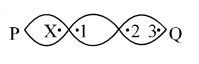
- 9Figure, shows a stationary wave between two fixed points $P$ and $Q$. Which point$(s)$ of $1, 2$ and $3$ are in phase with the point $X?$View Solution
- 10A tuning fork of frequency $392 Hz,$ resonates with $50 cm $ length of a string under tension ($T$). If length of the string is decreased by $2\%$, keeping the tension constant, the number of beats heard when the string and the tuning fork made to vibrate simultaneously isView Solution