MCQ
Two waves are given by ${y_1} = a\sin (\omega t - kx)$ and ${y_2} = a\cos (\omega \,t - kx)$ The phase difference between the two waves is
  • A
    $\frac{\pi }{4}$
  • B
    $\pi$
  • C
    $\frac{\pi }{8}$
  • $\frac{\pi }{2}$

Answer

Correct option: D.
$\frac{\pi }{2}$
d
(d) ${y_1} = a\sin (\omega t - kx)$
and ${y_2} = a\cos (\omega t - kx) = a\sin \,\left( {\omega \,t - kx + \frac{\pi }{2}} \right)$
Hence phase difference between these two is $\frac{\pi }{2}.$

Need a full question paper?

Generate a complete, print-ready paper with questions like this in minutes — across 16+ boards, with answer keys.

Start Generating Free

Similar questions

A block of mass $1\,\, kg$ is hanging vertically from a string of length $1\,\, m$ and mass /length $= 0.001\,\, Kg/m$. A small pulse is generated at its lower end. The pulse reaches the top end in approximately .... $\sec$
If the value of $‘g’$ acceleration due to gravity, at earth surface is $10\,m/{s^2}$, its value in $m/{s^2}$ at the centre of the earth, which is assumed to be a sphere of radius ‘R’ metre and uniform mass density is
A physical quantity $Q$ is found to depend on quantities $a, b, c$ by the relation $Q=\frac{a^4 b^3}{c^2}$. The percentage error in $a$, $b$ and $c$ are $3 \%, 4 \%$ and $5 \%$ respectively. Then, the percentage error in $\mathrm{Q}$ is :
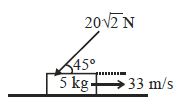
A block of mass $5\, kg$ is kept on a rough horizontal floor. It is given a velocity $33\, m/s$ towards right. A force of $20\sqrt {2\,} \,N$ continuously acts on the block as shown in the figure. If the coefficient of friction between block and floor is $0.5$ the velocity of block after $3\, seconds$ is ........ $m/s$  ($g = 10\, m/s^2$)
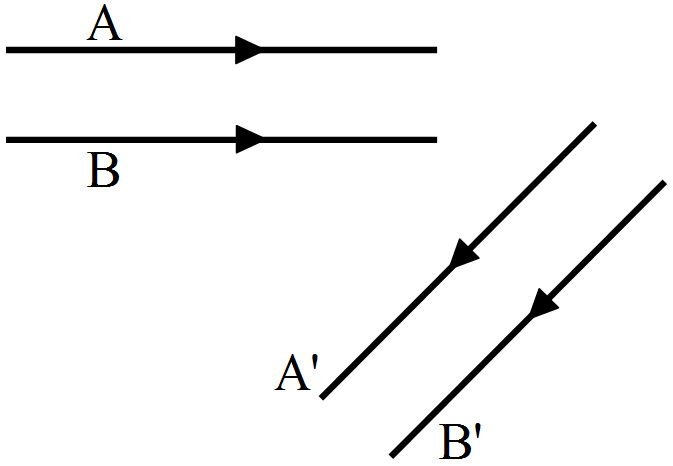
Two rays A and B being reflected by a mirror and going as A' and B'. The mirror:
A resonating column has resonant frequencies as $100Hz, 300Hz, 500Hz.$ Then it may:
The range of a particle when launched at an angle of ${15^o}$ with the horizontal is $1.5 \,km$. What is the range of the projectile when launched at an angle of ${45^o}$ to the horizontal ........ $km$
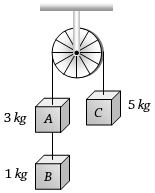
Three weight $A, B$ and $C$ are connected by string as shown in the figure. The system moves over a frictionless pulley. The tension in the string connecting $A$ and $B$ is (where $g$ is acceleration due to gravity)
A liquid of density $\rho $ is coming out of a hose pipe of radius $a$ with horizontal speed $v$ and hits a mesh. $50\%$ of the liquid passes through the mesh unaffected. $25\%$ looses all of its momentum and $25\%$ comes back with the same speed. The resultant pressure on the mesh will be
A body is rotating with angular velocity $\omega=(3\hat{\text{i}}-4\hat{\text{j}}-\hat{\text{k}})$ The linear velocity of a point having position vector $\text{r}=(5\hat{\text{i}}-6\hat{\text{j}}+6\hat{\text{k}})$ is: